


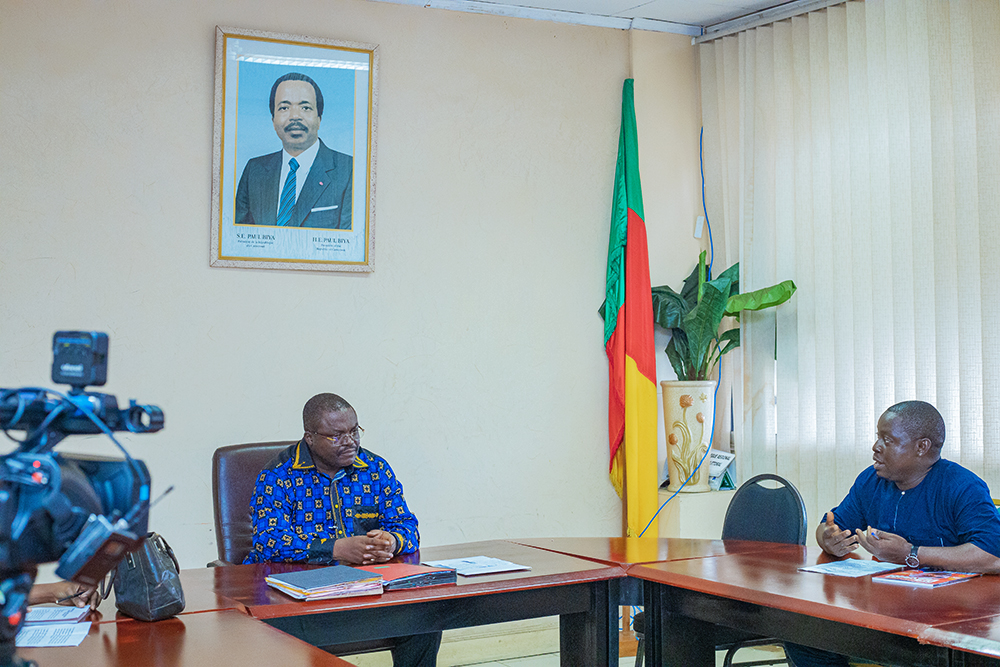
The Governor of Cameroon’s Littoral Region, H.E. Samuel Dieudonne Ivaha Diboua, has assured that foreigners living and doing business in Cameroon have nothing to fear. He went further to allay their worries, encouraging them relax and enjoy their time in the country.
In an exclusive interview with Naija Diaspora Magazine, he noted, “More than ever, the Central African country, famed for its hospitality and friendly atmosphere, is willing to open its doors to genuine and legitimate business prospectors, as this will ultimately translate to a win-win situation for both parties.”
Diboua made a name in governance and administration in Douala, Bonaberi, Nkongsamba, East Region and Yaounde in various capacities before he was appointed the Governor of the Littoral Region. Before his appointment, he was the Governor of the West Region (2010) and Eastern region (2012 – 2015).
While acknowledging that the Littoral Region is home to a large community of foreigners, most of whom are Nigerians, Diboua also commended the presence of foreign-owned companies in the region, particularly Dangote Cement, and the joy it has brought to his fellow citizens.
“By situating his manufactory in Douala, the Dangote Company has helped to maintain the price of cement at a good level in the country.”
According to Diboua, the vibrancy and competition the Nigerian company has brought to the market has forced competitors like Cimencam, CIMAF and others to bow to the rules of market forces and keep prices at a reachable level for average Cameroonians.
“This would not have happened if you were alone in the field,” Diboua added.


Aside from Dangote’s investment, he also commended the impact of other Nigerian businesses like Air Peace and MRS CORLAY, as well as banks like UBA and Access.
“The first General Manager of Dangote Cement in Cameroon was a Nigerian, but today it is a Cameroonian. Sometimes, you see that even a Cameroonian who goes to work in Nigeria also becomes a leader inside the company. So, we cannot say we are really foreigners—no, we are together.
He also acknowledged the contribution of migrant Nigerians in the area of vehicle maintenance.
“The Nigerian community is bringing a lot in terms of peace [FU1] of vehicles and the renowned Camp Yabassi. We have seen how our brothers are coming to help tackle the mechanical problems.
“We also have many Cameroonians traveling to Calabar, to Abuja, and coming back with business opportunities.”
Diboua ascribed the secret of his administrative success to Jesus Christ. He also assured that his administration would use ceremonies such as the National Feast Day to further strengthen ties with Nigerians and other foreigners.
This, he said, would promote a sense of belonging and the confidence to integrate with other Africans despite our border differences. He also noted the seamlessness with which nationalities of both countries interact and mingle across the borders, stating that it is a testimony that delineation is only on paper.
“Even the population are just speaking the same languages; English, Pidgin, this and that; same with the traditions. When you see how the people of Douala call the Sawa people, it’s not different from Bakweri and from Igbo and Calabar people; they are close to the Anglophone Sawa. We can actually see it’s wealth that we share with one another. Living together is a master key to good development between the two nations, and we are proud of it. We can say that it is good.” He reiterated.
The governor further spoke of his close relationship with some Nigerian spiritual leaders, with whom he exchanged prayers every now and then. He said both countries share similarities in many significant spheres, including culture and sporting achievements.
“I attended a wedding somewhere in the country where the Nigerian community came to ask the hand of a lady from Cameroon in marriage. And when we were just joking, one of the Nigerians said, ‘Ooh, this Cameroon. If we can make Cameroon a part of Nigeria at the level of football grounds to play in!’
“And then I said, ‘So Cameroon for you is a sports platform, a sports place to play.’ I also told him that for Cameroonians, Nigeria is a business land. Of course, when you talk of football, the two countries have to respect each other. Both have good players. That is why, in my speech, when I was installing the new Nigerian Consul General, I said our two countries are the only African countries that have won the Olympic Games Men’s Football gold.”
“We have the same physique, the same face, and even eating and clothing habits. If they stop sending Okra, Garri and Egusi, I think there will be a strike in Calabar. We thank God because the head of state, President Paul Biya and President Muhammadu Buhari are making much effort toward cooperation. We have the roads, the bridge of Ekok, and even the roads to Enugu. If we didn’t have the problem of secessionists and Amazonians, we probably would have more good, large roads, facilitating easy movement of people from Enugu to Douala.”
He expressed hope that more peace would be achieved in both countries to give room for more development and regional prosperity.
Notably, he also expressed hopes of improvement between both countries in the area of aviation.
“We don’t have many flights between the two. If we have them, I think that we can gain more in business.”
On Littoral Region, Cameroon, and Successful Hosting of AFCON
Speaking on Cameroon’s successful hosting of the African Cup of Nations (AFCON) for the second time in 50 years, Diboua said:
“We had two or three challenges. The first was to have beautiful stadiums, and the government, along with the head of state, worked so hard to ensure this was achieved.
The second was to fight against Covid-19 and to take measures so that people could go out and come back safely, whilst the third was at the level of insecurity. So, we worked hand-in-hand with the population, the gendarmes, and the policemen, to ensure people were secured everywhere.
“As a team, we won in these three challenges, and I’m glad for it.”
On the diplomatic front, where Governor Diboua has also distinguished himself, earning accolades amongst foreign diplomats, including those from Nigeria, he was quick to say that the success is a collective one.
“We have a Douala branch of the External Ministry here in Douala (the MINREX), and it is working very hard to strengthen the relations and even improve on them. We regularly hold meetings to see which paths to take to strengthen and improve the relations. The other thing is that every time the Nigerian community has a ceremony, they invite us to attend the meetings, assist, and even to share what is very common to us; and what can be more useful for everybody.”
The governor also commended Nigerians in the country for the respect they have shown to their host country by not meddling in its internal affairs and remaining law abiding.
Speaking on internally displaced persons (IDPs), Diboua said the country has its share, as well as refugees from Central Africa, Chad, and so on.
“When I was the East Governor, I saw that those who are based in the East Region are mostly fishermen; they are practicing agriculture. This category of people are not coming to Douala. Those coming to Douala are likely traders and businessmen coming to do business. That is why when we have to help them, the approach is different, and the emergency cases are the ones that leave in the East region of the North. But some of those who are here are teachers, engineers, and so on.
“Notably, this category of people has to integrate into society. Consequently, my government is working with the United Nations branch for refugees to give fleeing refugees a new way of life.”
Placements for these people are usually done carefully because, according to him, “we have to know who is who. We need to know that you are a valuable person in your country. But first, such immigrant has to be registered at the UNHCR.” Diboua said.
Another good thing, according to the governor, is the hospitality of the Douala people, who welcome migrants with open arms. To that effect, there are no camps in Douala. “Such hospitality is also enhancing growth.” He added.
“If there is a football match, you will see that there are many people there. If you go to Youpwe to see how you can buy fish, you will see many people there as well. They are living as brothers and sisters, and have made the place a kind of homeland. They are in peace within us, without any problem, but there is still a need for the international community to help and give sustainable measures to help them. We cannot do it alone.”
Parting Words
H.E. Samuel Dieudonné Ivaha Diboua would like everybody to be vigilant, as the world today is made up of tools that can be used for good or otherwise.
With particular reference to technology and the new media, the governor said, “You have to be careful because when information is given, it is better to go and ask the authorities if what you have heard is true or not.”
He also appealed for vigilance amongst citizens and prompt intimation of the authorities when things go wrong, while pledging confidentiality. This would serve as intelligence to help forestall unwholesome incidents.
“When we are living in a quarter and not behaving very well, it is good to come and tell us what is happening. But be sure I won’t stand and say, ‘Okay, Sister Esther told me that you have this and that.’ When we have information as professionals, we know how to handle it. So don’t let situations get worse; give good information in time, and we will react in time and ensure peace in our Littoral region. We cannot live in peace if we are not sharing information.”


