

[14:34, 19/02/2023] Mr Ismael 2: A famous Cameroonian musician, songwriter, entrepreneur and social activist, Ndifonka popularly known as Wax Dey, has cautioned Cameroonian artists and their Nigerian counterparts from fighting over amount of content from Nigeria being aired in Cameroon and vice versa, even though he is a staunch supporter of the promotion of local content (80/20).
Wax Dey, who always says Nigeria is a brother nation to Cameroon, made the statement while fielding questions by the Nigerian Diaspora Magazine on his opinion about the 80/20 campaign some Cameroonian entertainers have been heralding as best means to improve the industry.
“I started pushing for 80-20 back in 2016 after spending Easter with President Olusegun of Nigeria: he explained to us how a policy prioritizing local content helped to spur the music industry. That has been a key point of interaction in my meetings with Cameroonian leaders and lawmakers since. Other local platforms like Bimstr support this campaign actively on social media.”
He adds however that this does not need to be a cause for divisive outbursts or hatred.
According to the proposed regime, 80%of content played at clubs, receptions, Television station and radio and likes should be Cameroonian while 20 is foreign (including Nigeria).
Cameroon entertainers felt more value is given to Nigerians in their country while the same is not reciprocated by Nigerians in the clubs spaces. As a means to promote the Cameroon culture and revampe its values, the 80/20 campaign was adopted by humorist and socialist “Old Pancho”.
Measuring from that time of inception, Cameroonian musicians sort of won the 80/20 debate ; making a case why there is a need for the government to institute a quota of local music that must be played by local media houses and entertainment businesses.
The main argument put forward was that of other countries that had instituted similar laws to positive outcomes. This has been a heated debate on social media platforms.
Wax Dey, being the National Coordinator of the Cameroon Music Art pole, has worked over the years to not just put Cameroon but African music on the world map.
He was recently named the Central African Director for All Africa Music Awards ( AFRIMA). Wax Dey’s opinion to the fued which is seemingly fueling a sepration margin between Cameroon and Nigerian entertertainners, is that “Cameroon needs to collaborate more with Nigeria to grow”.
“What we are seeing is that people are increasingly calling for Nigerians to be boycotted” affirms Wax Dey. “This is a wrong interpretation of 80-20. By prioritizing local content, our artists will have more airtime, more shows, more income and will be able to both compete and collaborate better with Nigerians. At the end of the day, we have a lot to learn from Nigeria as an industry, and that will only happen through more collaboration. Cameroonian artists also perform a lot in smaller industries, so unity is a must.”
He sees “a possibility to market the uniqueness of Cameroonian arts on the global scene through fruitful collaboration with Nigeria”, noting that many countries have done that and it has worked out well for them.
However, though Cameroon ‘s Afro Pop music is not where it used to be, Nde believes and it’s putting the work to make his country a name on the global stage. But for that to happen, he believes 80-20, applied the right way, is a must.
Wax Dey is known in Cameroon to have fought a lot of silent battles for the industry.His role in the Ministry of Art and culture has much to do with this; he has been instrumental in making some great Central African and Cameroonian artists infiltrate AFRIMA , MTV Awards etc.
Wax Dey has learnt from the greatest culture promoters, and he says he owes his country the due to to ensure the growth of the Industry.
Going by Nde, the ancient Makossa , Bikutsi, Asiko, Njang genre, have remained the country’s cultural heritage; he enjoined millennials and up coming artists to revive it by creating a fusion of afro pop with these genres to create a unique blend because in any case, “we are proud of who we are”.
[14:36, 19/02/2023] Mr Ismael 2: Fans of Nigerian Afrobeats singer, Kizz Daniel in Cameroon, are yet to recover from spillover effects of the artist’s thrilling performance, at the concert organised by Cameroon’s giant brewery industry, Union Camerounaise de Brasseries (UCB).
Union Camerounaise de Brasseries (UCB) is one of the oldest and reliable company in Cameroon. Created in 1972 by its founder Fu’a Toula Kadji Defosso, UCB has been able to preserve its know-how and originality by preferring quality to quantity. A national socially responsible organization which, since its creation, has always known how to put ahead its patriotic side.
For its fiftieth anniversary, the 100% Cameroonian brewing company started its celebrations at the beginning of the year with the African Cup of Nation…
[15:23, 19/02/2023] Mr Ismael 2: Cameroon is sweet home for Nigerians-Consul General Bappah
Enamoured by the beneficial co-existence between Nigerians resident in Cameroun and their hosts, Nigeria Consul-General for the North West and South West regions of the Republic of Cameroon, Hon. Lawal Bappah has declared Cameroun as a sweet home to Nigerians.
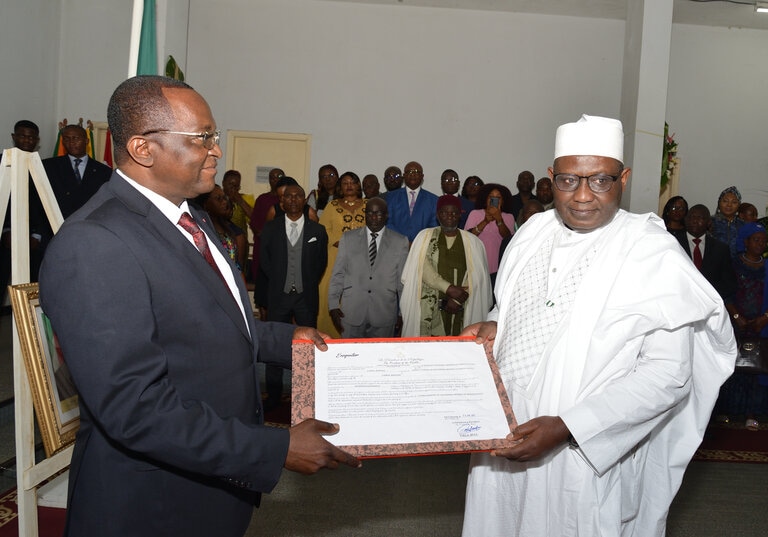
Bappah made the declaration at the presentation of the official letter of Exequatur by the Cameroon Governor of the South West region, Bernard Okalia Bilai, in office of the governor, Buea recently.
It was the ceremony designated for the handing of the “Exequatur” to the newly appointed Nigerian Consul General, CG for the South West and Northwest regions, Bappah during which Governor Bilai hailed the excellent diplomatic, economic, social relationship Cameroon and Nigeria share which spans through history.

Before handing the documents which recognizes the consul’s mission to Nigerians residing in the aforementioned regions, Bilai, acknowledged the attendance of Cameroonian authorities as well as the Nigerian foreign envoys to Cameroon at the ceremony.
“The Republic of Cameroon has remained a strong ally and strategic partner to the Federal Republic of Nigeria on the African continent.” By choosing to ally with Cameroon, Nigerian Head of States have shown the world the kind of influence Cameroon has in trade and political relationship. However,it has not been without challenges of security but the nations continue to fight together” he said
He quoted example of the Anglophone crisis where Nigeria stood by Cameroon in their fight against separatist terrorists, Boko Haram and COVID 19. Both governments have continued to show resilience through the Transborder Security committee “This expresses the zeal to maintain confraternity as people who have coexisted even before the establishment of both modern states,“ he added.
Upon handing the Exequatur, the governor enjoined Consul Bappah to promote and conserve the economic dynamism of Nigeria in Cameroon and ensure the preservation of its interest as stipulated in the exequatur, and coordinate the activities of the Nigerian community in his area of jurisdiction.
He also called on Nigerians to always collaborate with the CG in the excise duty which is to be executed in strict compliance with the laws and regulations.
It was a very bright event that brought scores of regional administrative and traditional authorities together, such as the Nigeria High Commissioner to Cameroon, Amb. Abayomi Olonisakin, Consul General of Nigeria in Douala, Queen Efe Alexandra Clark-Omeru, Defense Adviser, Captain (NN) Bimbo Agunbiade, Members of the Consular and Diplomatic Corps, Members of the Nigerian community, Collaborators of the governor, Religious and traditional leaders, Executive directors of companies and international organisations, Bappah’s wife, children and relatives among others.
In his remarks, Bappah counted it a great honour and privilege to have been graced by the presence of the Governor of the South West Region, he expressed appreciation to the President of the Federal Republic of Nigeria, Muhammadu Buhari, and the Hon. Minister of Foreign Affairs, H.E. Geoffrey Onyeama for finding him worthy of appointment as the Consul General of Nigeria to the North West and South West Regions of the Republic of Cameroon. Also, His Excellency Paul Biya, for graciously signing and transmitting his Exequatur through the Ministry of External Relations to the Governor of the South West Region.
“This benevolent act of the President of the Republic of Cameroon is a clear and undeniable expression of the excellent and unique bilateral relations that exist between the Federal Republic of Nigeria and the Republic of Cameroon,” he noted.
Consul Bappai did not leave out the contributions of the Nigerian foreign envoys to Cameroon to the success of his ceremony.
“I thank His Excellency Gabriel Abayomi Olanisakin, the High Commissioner of the Federal Republic of Nigeria to the Republic of Cameroon, HRM (Hon.) Queen Efe Alexandra Clark-Omeru, the Consul General of Nigeria to Littoral and West Regions of the Republic of Cameroon and all distinguished guests, both from within and outside Cameroon, who spared their precious time to attend today’s ceremony.
“Undoubtedly, the Republic of Cameroon is home away from home. It is in that light that I see it as a unique privilege for me to have been called to serve in the South West and North West Regions of the Republic of Cameroon to complement the efforts of our indefatigable High Commissioner with a view to strengthening and deepening bilateral relations with Republic of Cameroon; especially by addressing the consular needs of Nigerian nationals in accordance with the Vienna Convention on Consular Relations of 1963.
“As we continue to work and collaborate together in moving our two friendly countries forward, I wish to testify, without any reservation, that Buea is indeed a City of Legendary Hospitality and the entire Republic of Cameroon is Home away from Home,” he concluded.
Bappah, was born on July, 2, 1962 in Bauchi State. Before coming to Cameroon, he had served with the Nigerian foreign service at the Ministry of Foreign Affairs as the then secretary of the consular and immigration department from 1988 to 1991; he was appointed as second secretary at consular officer at the Consulate of Nigeria in Kuwait, 1992-1995, from then he was appointed as first secretary and counselor at the directorate to the ministry of foreign affairs.
Between 2003 and 2007, he was appointed Minister High Commissioner at the Nigerian Consul in Accra Ghana; other similar appointments and recognitions followed until his appointment as Nigerian Consul General for the South West and Northwest regions in 2021 following the departure of former Consul-General Ibrahim Bashir.
