Connect with us

diplomacy

Nigerians ‘Shut Down’ New York for Independence Day Parade

Published

on

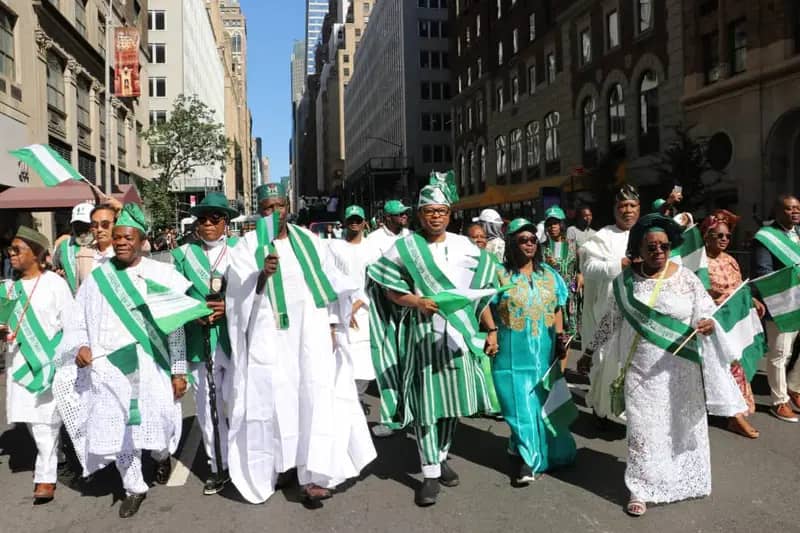
On Saturday, October 4, 2025, Nigerians across the United States transformed New York City into a vibrant tapestry of green, white, and pride as they celebrated Nigeria’s 65th Independence Day. The event, organized by the Organisation for the Advancement of Nigerians (OAN) in collaboration with the Nigerian Consulate General in New York and other partners, featured a grand parade and carnival that captivated thousands of attendees.

The parade procession, which stretched from East 38th Street to East 24th Street along Madison Avenue, effectively shut down the busy midtown corridor to traffic. It was led by the OAN, with participation from various groups, including uniformed contingents from the New York Police Department, the New York City Department of Correction, Nigerian cultural associations, professional bodies, religious organizations, and youth groups. The vibrant floats, traditional attire, and dance troupes drew cheers from spectators lining the streets.

Among the dignitaries in attendance were the Consul General of Nigeria in New York, Ambassador Abubakar Jidda; UN Deputy Secretary-General, Ms. Amina Mohammed; and the Acting Ambassador of Nigeria to the U.S., Ambassador Samson Itegboje. Other notable figures included Mrs. Ngozi Adeleke, wife of the Osun State governor; and Ambassador Nicholas Ella, a former Permanent Secretary in the Ministry of Petroleum Resources.

In his remarks, Ambassador Jidda congratulated Nigerians in the diaspora and commended the organizers for sustaining the parade and carnival annually since 1991 without fail. He emphasized that Nigeria remains a great nation, and 65 years of independence is worth celebrating despite its challenges. He also noted that Nigeria is the only African nation that hosts a full-scale Independence Day parade and carnival in New York City, a tradition that has positioned Nigerians as a visible and influential diaspora community.

Following the parade, the event transitioned into a full carnival at Madison Square Park, featuring electrifying musical performances and cultural displays. Popular Nigerian artist Bella Shmurda headlined the entertainment, thrilling the youthful crowd and energizing the festival atmosphere. The carnival also showcased performances by Chinese dance troupes, highlighting the multicultural spirit of the event. Attendees enjoyed a variety of Nigerian dishes, including jollof rice, suya, and puff-puff, creating a festive and communal atmosphere.

The 2025 Nigeria Independence Day Parade and Carnival was more than just a celebration; it was a statement of pride, unity, and resilience. It highlighted the achievements of Nigerians in the diaspora and reinforced the importance of cultural preservation and community engagement. The event also served to strengthen Nigeria’s image abroad and foster ties between the U.S. and Nigeria.

As the Nigerian diaspora continues to thrive globally, events like these not only celebrate freedom and heritage but also project a positive image of Nigeria to the international community, reminding the world of the resilience, talent, and spirit of its people.

diplomacy

MFA Minister of State Approves New Media Team to Strengthen Strategic Communications and Public Diplomacy

Published

on

The Honourable Minister of State for Foreign Affairs, Ambassador Sola Enikanolaiye, has approved the appointment of a new media team to strengthen strategic communication, digital engagement and public diplomacy at the Ministry of Foreign Affairs.

The appointments, according to a statement issued by the Ministry’s Spokesperson, Kimiebi Imomotimi Ebienfa, are aimed at supporting the effective communication of the Ministry’s mandate and the Renewed Hope Agenda of the Federal Government.

The newly appointed media team comprises Mr. Richard Elesho, who will serve as Special Assistant on Media and Strategic Communications, and Mr. Raphael Oni, appointed Special Assistant on Digital and Public Diplomacy.

The two communication professionals bring decades of combined experience spanning journalism, government communication, public affairs, diplomatic reporting, digital communication and media management.

Elesho Brings Extensive Government and Media Experience

Mr. Richard Elesho is a graduate of Delta State University, Abraka, and Kogi State University, Anyigba.

He previously served as Chief Press Secretary and Director General of Media Affairs to two former Governors of Kogi State, Alhaji Ibrahim Idris and Captain Idris Wada.

Prior to his new appointment, Elesho was the North Central Bureau Chief of The News/PM News, one of Nigeria’s established media organisations.

His extensive experience in political and government reporting, public communication and media relations is expected to contribute significantly to the Ministry’s strategic communication efforts.

Raphael Oni to Drive Digital and Public Diplomacy

Mr. Raphael Oni brings over 15 years of experience in government communication, public diplomacy, international relations and diplomatic reporting.

An award-winning photojournalist and diplomatic correspondent, Oni holds a Master’s Degree in International Relations and Diplomacy from the University of Abuja.

He is the Publisher of Diplomats Extra Magazine, a publication he founded in 2013 focusing on diplomacy and international affairs. The magazine has built a readership among Ministries, Departments and Agencies of government, diplomatic missions and other stakeholders in Nigeria and beyond.

Oni has also served two terms as Secretary General of the Diplomatic Correspondents Association of Nigeria (DICAN) and as former Secretary General of the NUJ Correspondents Chapel, Abuja.

His background in diplomatic journalism and public diplomacy is expected to enhance the Ministry’s digital communication strategy and its engagement with local and international audiences.

A Strategic Step for Modern Diplomacy

The appointment of the new media team comes at a time when effective communication has become increasingly central to modern diplomacy and international relations.

Beyond reporting the activities of the Ministry, the team is expected to play an important role in communicating Nigeria’s foreign policy priorities, projecting the country’s image internationally and strengthening public understanding of the government’s diplomatic engagements.

With the growing influence of digital platforms, strategic communication and public diplomacy have become critical tools for governments seeking to engage citizens, the international community, diplomatic missions and global stakeholders.

The Ministry expressed confidence in the capacity of the two appointees to contribute meaningfully to its communication objectives and called for the necessary support and cooperation towards a cordial working relationship with the new team.

For Nigeria’s diplomatic community, media stakeholders and the Nigerian diaspora, the development is expected to further strengthen the communication of Nigeria’s foreign policy and diplomatic activities both at home and abroad.

Continue Reading

diplomacy

Cynthia BULOT

Published

on

Born in Libreville, Cynthia Bulot embodies a new generation of African creators who transform emotion into a visual language. A self-taught painter, she discovered her calling three years ago during the lockdown period, when the silence of the world gave rise to a profound new passion: painting. What might have remained a simple pastime quickly became an artistic revelation and a unique path of self-expression.

Since then, Cynthia Bulot has pursued a captivating creative journey, guided by the power of color, the sensitivity of gesture, and a deep search for meaning. Through each canvas, she explores not only shapes and textures, but also the roots of her own cultural identity. Her work becomes a dialogue between personal memory and collective heritage.

The paintings of Cynthia Bulot invite viewers into an intimate immersion in childhood memories, where images of the past are released from shades of black and white and reborn through a vibrant, luminous palette. Each composition celebrates transmission, joyful nostalgia, and the richness of ancestral traditions, subtly reimagined through a contemporary sensibility.

Through her sincere and instinctive art, Cynthia Bulot affirms that creativity can emerge in the most unexpected moments and become a powerful force for renewal. Her pictorial universe—authentic, bold, and deeply rooted—deserves the attention today of art lovers and international cultural circles alike.

By Uche EJIMS

Continue Reading

diplomacy

Equatorial Guinea 2035: A Bold Vision for Sustainable, Inclusive, and Globally Integrated Growth

Published

on

Straddling the strategic heart of the Gulf of Guinea, Equatorial Guinea is leveraging its institutional stability, rich natural endowments, and prime geographic location to chart a decisive path toward becoming an emerging, diversified, and resilient economy by 2035. This ambition, formalized in the National Sustainable Development Strategy “Agenda Guinea Ecuatorial 2035” (adopted in 2021 following the Third National Economic Conference), aligns closely with the African Union’s Agenda 2063 and the UN’s Sustainable Development Goals. It marks a deliberate shift from hydrocarbon dependence toward a balanced model of growth that prioritizes people, productivity, and planetary health.

The strategy rests on four interconnected pillars that mirror the user’s outline, providing a coherent roadmap for transformation in a region—and a global context—marked by energy transitions and economic volatility.

Eradicating Poverty, Social Inclusion, and Lasting Peace

Equatorial Guinea has anchored its development in social cohesion and stability as non-negotiable foundations. With poverty rates hovering around 50-57% amid recent economic pressures, the Agenda 2035 prioritizes massive investments in education, vocational training, healthcare access, and targeted inclusion policies for youth and women. These efforts aim to address multidimensional poverty, including nutrition, water, and basic services, while fostering a peaceful environment that attracts long-term investment.

In a volatile Gulf of Guinea region, the country’s relative institutional continuity offers a comparative edge, enabling a focus on shared prosperity rather than conflict. Progress here is essential: recent World Bank assessments highlight that sustained gains in human capital and social protection will be critical to reversing poverty trends exacerbated by food inflation and hydrocarbon decline.

Boosting Productivity, Economic Diversification, and Industrialization

Oil and gas have long dominated (still accounting for a large share of GDP, exports, and revenues), but maturing fields and declining production—evident in recent contractions—underscore the urgency of transformation. The Agenda 2035 drives a strategic pivot through:

– Development of industrial zones and local processing
– Modernization of ports and logistics
– Sustainable agriculture and agro-industry expansion (including revival of cocoa, coffee, and value chains like coconuts)
– Support for innovation, entrepreneurship, and emerging sectors such as the green, blue, digital, and “yellow” (likely agro/mining-related) economies

The goal is clear: generate quality jobs, add value domestically, and position the country as a competitive hub in Central Africa. Reforms to improve the business environment, financial inclusion, and infrastructure are underway, complemented by efforts toward WTO accession and private-sector-led growth. Non-hydrocarbon sectors are already showing resilience, though challenges like governance gaps and infrastructure deficits remain.

Environmental Sustainability and Territorial Development

With exceptional biodiversity—from tropical forests to marine ecosystems—Equatorial Guinea is embedding sustainability at the core of its vision. Priorities include preserving forests (via REDD + initiatives), advancing renewable energy, promoting balanced urban planning, and developing responsible ecotourism. Sites on Bioko Island and mainland national parks hold untapped potential as authentic, high-value destinations.

This pillar directly tackles climate risks and the post-oil transition, with strategies for low-carbon development and ecosystem services (e.g., wood processing linked to ecotourism and agriculture). An integrated approach—combining land-use planning, clean energy, and sustainable farming—could simultaneously protect natural capital and drive inclusive growth.
A Strategic Magnet for Investors and Tourism

Equatorial Guinea presents itself as an investor-friendly destination through political stability, ongoing economic reforms, modernizing infrastructure, and privileged access to Central African markets. Parallel efforts are elevating tourism with a premium offering: pristine nature, African hospitality, and upgraded facilities. Recent initiatives target barriers to entry and promote ecotourism as a diversification lever, while partnerships in fisheries, agro-processing, and digital sectors broaden appeal.

Outlook: A Model for Balanced African Development

By 2035, Equatorial Guinea aims not merely to adapt but to exemplify a new African development paradigm—one that harmonizes economic expansion, social equity, and environmental stewardship. This vision resonates with broader continental initiatives that seek to accelerate growth, deepen regional integration, and elevate Africa as a hub of innovation and opportunity.

Implementation will test resolve amid real headwinds: declining hydrocarbon revenues, the need for stronger governance and human capital investment, and global uncertainties. Yet the foundations—strategic location, resource base, and explicit policy alignment with global agendas—position the country to attract structuring partnerships and revalue its potential on the world stage.

Equatorial Guinea is more than a destination; it is a compelling opportunity for investors, partners, and visionaries committed to sustainable African success. With disciplined execution, the 2035 horizon could mark the emergence of a diversified, inclusive economy that delivers prosperity for its people while contributing meaningfully to the continent’s rise.

This narrative, rooted in the official Agenda 2035 framework, offers a forward-looking yet grounded perspective suitable for international news or investment publications—highlighting ambition without overlooking the structural shifts required for realization.

By Uche EJIMS
Making Africa Great Ahead
MAGAH

Continue Reading

Trending