

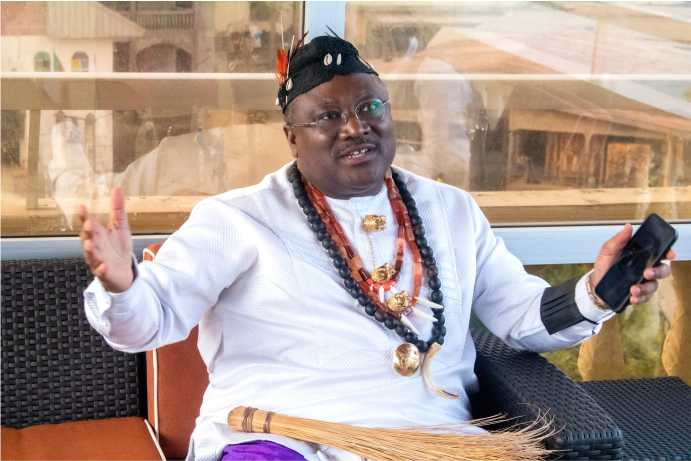
Before he ascended to the throne of his forefathers as the paramount ruler of the Bafaw people in Cameroon, HRM Ekoko MUKETE (Nfon Mukete IV) Nfon of Kumba and Paramount Ruler of the Bafaw, had been a respected captain of industry in Africa. In an interview with Naija Diaspora Magazine crew, he sheds more light on his trajectory.
How do you see your new role and what message do you have for your subjects, including the vibrant foreign community living within your kingdom?
In terms of my role, as you know, my father the year before, joined the Lord; he had the opportunity to hand over to me, speak to me and showed me the road and guided me so much on how to serve my people. I was really privileged and had the opportunities many leaders don’t have as paramount rulers. How I see myself as paramount ruler of Bafaw is that I want to empower my people, I want to bring a modern touch to the chieftaincy system and I want to make sure that I am ruling not based on fear but on being appreciated; having the wisdom to rule the people, being respected and bringing value to them. Ultimately, I want to serve my people.
As an influential paramount ruler, business man, philanthropist, diplomat and more, what are the ways you think Cameroon can be projected to the world?
We have not taken advantage of the opportunities, but it is never too late to start. My prayer really is that with the successful hosting of AFCON where a side of Cameroon was shown to the world, even Cameroonian themselves were surprised that we could really do this. And we did it with such style that not just Africa has admired what we were able to do but across the world, people have said ‘truly Cameroon is a great country’.
I think that we can build on that to start expanding our tourism sector. I have always said that tourism in Cameroon is underleveraged. The budget allocated to the Ministry of Tourism is too small. The profile of the Ministry of Tourism should be completely different because Cameroon has a huge tourism potential not being used at all. We need to revisit that sector, especially now that there is a big push towards import substitution and the necessities to have more foreign exchange earnings. There is no better sector to transform the economy of a nation than the tourism sector.
If you look at every developed country in the world, the number one income earner is tourism; in Turkey, Great Britain, France, the United States of America, even China. As it is, we don’t have a choice; it is what we have to revisit and I believe that it is what we have to see in the near future.
Permit me to engage you on your journey as the immediate past Board Chairman of the United Bank for Africa Cameroon (UBA Cameroon) for 13 years. How can you highlight your achievements to the benefits of the country then?
I got on very well with UBA senior management in Cameroon also the group headquarters in Lagos. The Group Chairman, Tony Elumelu was very supportive and I learnt a lot from him. I am very much feeling the DNA of UBA after 13 years of service on the board of UBA Cameroon. Even till today, I still sense the impact of UBA; that’s why you saw me as part of Tony Elumelu’s delegation when he recently visited Cameroon; he said ‘I can’t come to Cameroon without you being by my side’. That tells you how far we have gone and that’s a natural instinct that goes on, in terms of myself and UBA. It’s almost as if I don’t want to leave, because it was such a great experience and a great bank indeed.
Over 5 million Nigerians are living in Cameroon, and we have lots of Nigeria’s top businesses in the country like Dangote, UBA, MRS. How do you assess the relationship between Cameroon and Nigeria and which other areas do you think the two countries can collaborate for the benefit of their communities?
It has generally been a smooth relationship and this has gotten better. I quite remember some years back when we had the Nigerian army marching on 20th May National day Celebrations in Yaoundé with the Cameroonian army; I can never forget that, and it was so important to see that happen to show the inherent friendship between Cameroon and Nigeria.
The fact that Nigeria with 200 million people and more and Cameroon with 27 million people can enter into a bilateral agreement whereby there could be free movement between the two countries is something to be Cherished.

In most cases today, African countries have this phobia that a larger country like Nigeria will come and take over our cities and people begin to be scared about the possibility of it happening. But it was amazing for Cameroon to accept such free movement agreement with Nigeria because there is nothing to fear about. And so far, Cameroon has not been overrun by Nigerians.
We have Nigerians here trading and Cameroonians in Nigeria doing well; There is cordiality and understanding between the two countries. It has been a uniquely beneficial relationship between the two countries. And we signed an accord with the Nigerian government over the fight on insecurity.
President Muhammadu Buhari and Cameroon’s President Paul Biya’s relationship has gone deeper to the extent that even in fighting terrorism and securing borders, there has never been fear of being over crowded. It has been one of mutual and respected trading relationships from both ends.
I was looking at trading figures between Nigeria and Cameroon and it is true that the balance of trade is so much in favour of Nigeria; in fact, it was around 550 billion XAF. Of course, at a point, I was feeling like this is unfair, but sincerely, not really because a lot of those figures are coming from petroleum products coming into Cameroon.
Of course, there are lots of products leaving Cameroon to Nigeria as well which I think we can also generate and compare, but most times a lot of things are not recorded, usually in agriculture products and other primary Products. But I think there’s room for growth. In the area of tourism, the Nigerian middle class and upper middle class do a lot of travelling.
In fact, each time you want to talk to somebody in that bracket, they are either having a birthday in Dubai or an anniversary in London or marriage ceremony in Europe. And I always thought that Cameroon could be a good destination for them to come over and celebrate with us.
We are naturally welcoming and you saw that during the AFCON. And I think Nigerians feel at home here. And of course, the Nigerian diaspora here can testify to that. But we will like more Nigerians to come and spend some money on vacations, feel good in Cameroon at any point in time. Also, in the industrial sector, Nigerian owned business such as Dangote have been very successful in Cameroon. we want to see more of that.
You talked about the Nigerian Ambassador to the Republic of Cameroon His Excellency, Abayomi Olonisakin, how do you see him as Nigerian Ambassador and a former defence chief of staff in Nigeria?
He is impressive. I have had the privilege to be with him and his wife; he’s such a fantastic fellow. And behind every great man is a great woman. What shocked me at first is his simplicity, having held the position of Chief of Defence Staff in Nigeria, a very important hierarchy.
When I met him, I was amazed at the attention he gave to me and the way and manner he handled the situation. I think these are some of the attributes President Buhari must have seen in him before appointing him to Cameroon. He’s such an honorable person indeed and a good listener. Cameroon is blessed to have him as an Ambassador.
Since he came in, he has been moving around to carry out his duties diligently and we have been seeing a lot of improvement. His faith level also impressed me; I saw a man purely dedicated to the Almighty God. Even people of other faiths don’t find it threatening because he is a man who respects others; he does not discriminate whatsoever. It is an honor to know him.
You happen to also be the Honorary Consul of Turkey, what are your functions and does this impact your role of a traditional ruler?
Yes, I have been the honorary consul for Turkey to Cameroon; resident in Douala for over 11 years and counting. I am also the President of the Cameroon Turkey Business Council (CTBC). Presently, the relationship between Republic of Turkey and Republic of Cameroon have been excellent.
Today, we have seen the significant presence of Turkish businesses and products in Cameroon; Turkey Airline has daily flight between Cameroon and Turkey and we have seen a steady increase in trade between the two Countries.
As a Traditional Ruler, I find that my role as Honorary Consul of Turkey is instead enhance as it gives me additional leverage and authority that benefits both Turkey and Cameroon in many ways. The Turkish government is happy about my traditional stool and the cultural diversity this adds to the relationship.
Can we also regard you as a philanthropist due to your various humanitarian gestures in Cameroon and as a traditional ruler, what inspires you about empowering people?
Well, I can see myself in that role. I enjoy the act of giving, it is part of me, and God has always been leading me in that direction. I love reaching out to the needy and touching lives in various ways within my reach. I have worked with orphanages even before now, so I understand the system involved in reaching out to people in every part of Cameroon. My wife has also been fully involved in the humanitarian work and we have been involved in touching the lives of street kids in Douala and other parts of the country. Today, the Nfon’s palace Kumba has regular outreach programs to help the less privilege in Kumba and its environs.
Going by your family background, you came from a rich and influential home, also your dad was one of the most respected personalities in the country and Africa… It seems you are building emphatically on the success of your dad…
I think the perception from the public is that the Mukete family is a big family because it is an influential family. I think one of the great strengths is the quality of exposure we have had. It is no longer news that my father was educated in Manchester University and Cambridge University, UK. He was also a minister in Nigeria and served under the Tafawa Balewa government and he was actually the last man standing until his Passing to glory last year April 10, 2021. Having served in such a large country like Nigeria, coming back to Cameroon was also very important; and he became a very influential man in many aspects.
By the time he left, he was the oldest Senator. As a matter of fact, I grew up with that solid foundation of my father which I can only build on. Being his successor is quite a big shoe to fit in, even though I had a time with him to understand what he wanted for his tribe and so on. I am basically trying to build on that vision. I know every father wants their children to do better than they do, and I know God willing, I will do better than my dad and my son will also do better than me. My road map is very tied to his vision and I spend no effort in doing the things that he wanted.

Despite your interesting resume, you were recently named Canyon’s new non-executive director. How do you feel sir? To what advantage would this elongate your journey as an influential traditional ruler?
In other things I have done, recently I joined the CAMALCO Cameroon SA Board of Director, a wholly owned subsidiary of Canyon Resources Ltd as Non-Executive Director (an Australian mining company). I am Excited by the by the project and can see the enormous benefits for Cameroon by having this important project come into production.
As an influential traditional ruler in Cameroon and having extensive business experience in the public and private sectors, I believe that I will add a unique perspective to CAMALCO and hopefully help fast track the development of this project.
Do you see yourself emulating your father’s legacy?
Tough one, big shoe to fit in, like I explained before, I cannot just copy what he did, I must live my own life; I run the palace and the chieftaincy in my own way. But of course, using his guiding principles, I could call it the guiding biker which he left with me but the passage in the middle will be my own way.
I believe so much in the direction of the Holy Spirit and the Holy Spirit has always been my ultimate guide. So that’s my strength as a believer. My father always told me that my faith is my strength and I should hold on to it. Also, one of the things I always take seriously is my family life, you don’t find me bouncing around places, jumping to corners. I tried to honour my family, to live an honorable life, to keep my word, to be a good example to younger ones as well as to make people happy by bringing out their best. My father had an amazing legacy, to beat that record would be really tough but it is possible. My goal is not essentially to beat his record, my goal is to become the absolute best of myself.
While growing up, what was your biggest ambition before you attained the position of paramount ruler?
I had always liked banking, and I am glad being ended up as board chairman of a bank. I love Advertising; the Electronic Media and Real Estate Development. I have a passion for it. My ambition was never to be a traditional ruler to be honest. My faith is very strong and that’s why I have a unique way of doing things, right from my dressing as well as my reasoning, I put the Almighty God above everything. I don’t see my belief contradictory to my role as traditional ruler and I also make efforts to ensure I dress well traditionally, as well as to be excellent in whatever I do. I always like to present my culture in an admirable fashion; other people can look at it and admire it. Some people come to admire my outlook and use that opportunity to take pictures and ask for a blessing while at it. It is an honor to b a blessing to others.
To answer your question, I think I wanted to be somebody that just wants to make a difference in society. I also have a passion for philanthropy. I wanted to grow up and make money to be able to give it out. It is something I love to do and I believe that’s the greatest pleasure. To be able to go to orphanage homes, provide for the needy and so on. There has been a time in my life that I prayed to God to show me who to attend to. I could remember a day I just finished praying to God to give me a direction on whom to extend gestures to, only for me to get to my gate and see many physically challenged people in front of my gate waiting for me. I quickly told myself God has shown me the way already.
If you truly want to give out, let God lead you and you will be amazed to see it happening and that’s my case. And what’s also beautiful about the story is that He will also give you the resources to do it. He will never give you an assignment without a provision. Sometimes, it can be disheartening when people try to take advantage of it in such a way that they see it as a means of exploitation.
It is very discouraging. They do that to me all the time in the neighbourhood. Some people will even abuse you for giving but that shouldn’t allow you to be wary of giving. You should never stop.
And I have tried to enjoy that in my life and I have it that I should always be in that position to do more and more and that brings me to my role as a traditional ruler. My father used to tell me all the time that he’s so disturbed about the poverty level out there. He kept lamenting why people couldn’t go into farming and improve their lifestyle. My dad used to travel a lot and made research on how to bring about transformation in his community. He even mentioned this on the floor of the Senate. I guess the research continues…
How do you measure success, and what advice do you have for upcoming businessmen and women?
My advice is that everyone should stick to their talent. Focus on what you are good at and don’t keep copying other people when you don’t have the full pictures. If you are good as an engineer, kindly stick to it; there will be a time when it is going to pay you beautifully.
The problem I see usually with people is that for example, a learned lawyer who is supposed to focus on his law firm or manage it, would be busy with a plantation somewhere in the village of which he can’t have control. Just like a doctor who is supposed to be learning more about his trade, running a bakery is a distraction.
I do a lot of things but what I make sure to do are things that are interrelated and can leveraged to give overall better results. At the end of the day, I want to see myself as a traditional ruler with a great vision, not as a juju man. I am a traditional ruler who can serve his people without fear, empower his people, and guide his people to prosperity. And to do that, having a link to industry, the entrepreneurial sectors and so on is critical.
I have found out my ability as a traditional ruler to meet the aspiration of my people is also linked to receiving people, solving problems either personal or economic; and helping them find employment opportunities for their children.
So, most of the things they are asking from me have lots to do with my ability to have good links in government / public sector, and more importantly in the private sector which is the engine of growth in every economy.

Also, traditional ruler needs to be financially strong y because people are coming to ask for financial help. In the Northwest region, the culture is such that the traditional ruler would sometimes receive financial support from their subjects, whereas in the Southwest region, people usually come to take from the traditional ruler; so, i need a lot of resources to meet the needs and expectations of my people.
Of course, you want to also empower them to be able to create wealth for themselves. So, all of these are tasking but I am ultimately enjoying the challenge.
Cameroon has made Africa proud by successfully hosting the AFCON 2021, how can you rate the hosting by Cameroon and what advice would you give to other African nations aspiring to host events of this magnitude?
Absolute excellence! I am not saying this because I am a Cameroonian, I was extremely proud of what happened, though at a time I was somehow worried about the organization.
In the standard organization of hosting a competition like AFCON, you meet some large multinational companies like Coca Cola, Nestle, Pepsi etc and get them involved early at the organizational stages. They by being involved can also bring in the advertising dollars to substantially bankroll the cost of the event. This is where I became worried because Cameroon didn’t go through that route. What Cameroon did was to go for a Greenfield, totally fresh approaches to hosting a competition of this size and it paid off. However, time will tell if it was financially wise to take this route.
Now, the question is how we monetize this great experience. It was a success. The success was so amazing that I will not want to attach it with a full post-mortem review. I am happy to take what we got. It makes me proud, my friends across the world have commended us for hosting a successful tournament and I believe we can really build on the success and try to monetize it for the Cameroonian economy.
With the infrastructure we have been able to put out, we should be able to host more continental competitions and we will be always ready because we have the infrastructure capacity in place already. And we hope some event managers will also come to make use of the facilities. Finally, we hope young Cameroonians can improve on their sporting skills and excel in the world of sports.
