

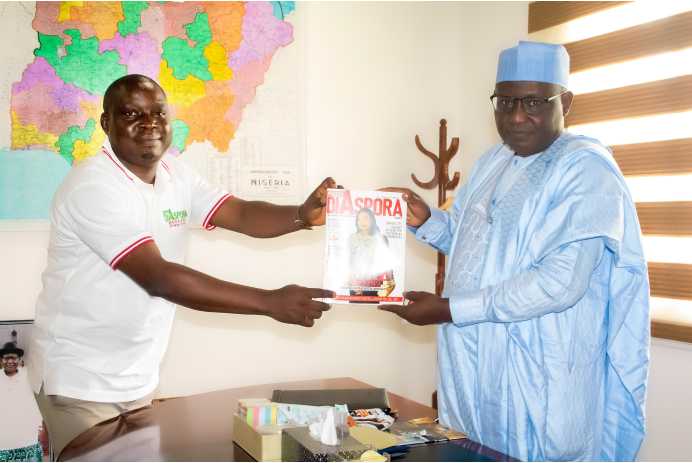
Consul General of Nigeria to the North-west and South-west Regions of Cameroon, Lawal Bappah is an accomplished diplomat who has, in the course of his career, served in different countries such as Kuwait, Ghana, Morocco and China before his current appointment. He assumed duty as Consul-General in Buea on 3rd October, 2021. In this interview, he reviews his career and his experience in Cameroon. Excerpts
Since your arrival in Cameroon, what surprises have you encountered among Nigerians and the host country?
I have not encountered any surprise since my arrival into the country on 30th September, 2021. I was well received by officials of the Protocol Department of the Ministry of External Relations and have successfully interacted with host authorities and members of Nigerian Communities in both the North-West and South-West Regions of Cameroon.
Cameroon is a bilingual country with English and French as its official languages and you are in charge of English-speaking compatriots. How do you intend to interact with your French speaking audiences?
Yes, since Cameroon is officially bilingual, there is no barrier and I should be free to express myself in any of the two official languages (English or French). I have been interacting comfortably with people in my area of jurisdiction, the English-Speaking Regions of Cameroon. That notwithstanding, I have previously served in a Francophone country, Morocco, where French was the language for diplomatic communication, and I have since then been making efforts to improve my understanding of the language. So, there is no problem at all about that.
As an experienced Nigerian Diplomat, who has travelled around the world, how do you think Nigeria can tackle the insecurity challenges within our borders?
Nigeria will continue to work towards boosting security cooperation with all its neighbouring countries of Cameroon, Chad, Niger Republic and Benin Republic. The Multi-National Joint Task Force (MNJTF) should be fully equipped to check proliferation of small arms and light weapons across our common borders. Special attention should also be focused on the cross-border insecurities by separatists between Cameroon and Nigeria. I have served in various countries of the globe and I am aware that all countries have their different challenges. The security challenge is everywhere in the world today.
The Nigerian government is not sparing any efforts in ensuring the security of the country and more will still continue to get done. On 16th November, 2021, Manga village in Takum Local Government Area of Taraba State, Nigeria, was attacked by suspected Ambazonia fighters, that are yet to be identified. President Muhammadu Buhari has promised to hand over a more secure and prosperous country by 2023. The Nigeria-Cameroon Mixed Commission needs to consider appropriate measures to be taken by the two countries to tighten border security and prevent cross-border incursions. I feel Nigeria and Cameroon should continue to strengthen cooperation to resolve common security challenges; especially along their common borders in the North-West and South-West Regions.
There have been insecurity issues also in your area of jurisdiction, the North-West and South-West Regions of Cameroon that have affected fellow Nigerians. What do you have to say about this sir?
I have been holding a series of meetings with Nigerian communities where I continue to enjoin them to continue to be law abiding and to obey local laws. As I said, the issue of insecurity is everywhere; home and abroad. I wish to urge fellow Nigerian compatriots in the North-West and South-West Regions of Cameroon to be extra-ordinarily vigilant and security conscious; not to be victims of any evil.
We now live in volatile societies and there is need for everyone to be security conscious; especially with the recent heightened twist in the Anglophone crisis which we are praying and trusting God, will become a thing of the past in no distant future.
Nigerians living in Cameroon have boosted the economy with their various businesses whilst several companies also keep coming from Nigeria to establish in this country. What is your reaction about this and how do you appreciate business climate in Cameroon?
Nigerians are highly enterprising and are everywhere in the world. However, their increased presence in Cameroon is traceable to a good number of factors, which include the natural and geographical location of the two countries closely together. Cameroon shares a lot of historical, geographical, cultural, social and religious ties with Nigeria.
In addition, Nigeria and Cameroon are two neighbouring countries with long standing very cordial bilateral relations. Before the sudden outbreak of the novel COVID-19 and the ongoing twist in the spiraling Anglophone crisis, economic cooperation between Nigeria and Cameroon had been robust.
The geographical location of Cameroon has placed it as a strategic economic partner of Nigeria. The Nigeria-Cameroon economic relations had improved over the years; especially in the area of trade and investment. There had also been an increase in the presence of Nigerian investors in Cameroon, such as Dangote Group, United Bank for Africa, Ecobank and Air Peace Airline that have established presence in Cameroon.
There is also a huge and vibrant number of Small and Medium Enterprises owned by Nigerians living in Cameroon; most of who conduct their businesses at informal levels. There are many Nigerian goods like electronics, motor spare parts, cosmetics, building materials, fuel etc; that enter Cameroon on daily basis.
There are also many Cameroonian products; especially foodstuffs like garri, eru, palm oil, spices, bananas, cocoyam etc that enter Nigeria via Idenau beach on daily basis. Regrettably however, official report between 2015 and 2019 shows that the value of trade exchanges between Nigeria and Cameroon dropped by 81% from XAF 15.6 billion to 2.9 billion.
The reason for those significant drops is that the over 1500-km long border western Cameroon shares with Nigeria is close to the Northwest and Southwest regions affected by the Anglophone crisis as well as far-North plagued by the war against Boko Haram. I hope there will be improvement when peace reigns and the closed borders are opened to facilitate cross border trading activities.
Having up to five million Nigerians in Cameroon means the country really has something special to offer. How do you assess the hospitality of Cameroon?
Yes, you made an assertion in your preceding statement, that Cameroon has something special to offer. I agree with that because it is an indirect allusion to what I said earlier, that Nigeria and Cameroon have a lot of things in common and to benefit from each other, culturally, socially and especially economically.
Regarding hospitality, I can say without mincing words that Cameroonians are wonderful people. They are friendly and highly hospitable. This had been much proved to me again and again in the course of my courtesy visits to host authorities in Buea.
Members of Nigerian Community in South-West and North-West Regions of Cameroon have also confirmed that they live in peace and harmony with their Cameroonian counterparts. They carry out their trading, farming and fishing businesses without let or hindrance from relevant authorities. Even though there are some complaints of harassment and extortion of Nigerians in some cases, on a general note, Nigerians feel free as they carry out their economic and social activities in Cameroon.
When I paid a courtesy call to the Chief of Great Soppo, Buea, he invited Nigerians living in that community and they came and presented some cultural displays. On the occasion, HRM Etina Monono conferred on me the royal title of “EYOLE” which was translated to mean “Peace Maker”. It is a little wonder that Buea, in Southwest region of Cameroon is called “home of legendary hospitality”.
What should Nigeria in areas of your command be expecting from Your Excellency as regards their welfare and well-being?
Nigerians in the South-West and North-West Regions of the Republic of Cameroon, will continue to receive good consular services from the Consulate General of Nigeria, Buea. The Consulate offers consular services to Nigerians and foreign nationals, including Cameroonians in innumerable ways.
The Nigeria High Commissioner, H.E. Gabriel Olonisakin, has been moving round Cameroon to ensure stability among Nigerians. What are you also doing to assist his efforts as Consul General?
The High Commissioner, H.E. Ambassador Abayomi Gabriel Olonisakin, as Nigerian Principal Envoy to the Republic of Cameroon is responsible for the promotion of bilateral relations between Cameroon and Nigeria. As the Consul-General of Nigeria to the North West and South West Regions, I am complementing the efforts of the High Commissioner in promoting and protecting the welfare of Nigerians within my Consular jurisdiction.
Other than the Nigerian National Day on 1st October that brings Nigerians together, could you in your capacity initiate other events that will bring Nigerians together to showcase their culture, food, dances, talents etc.
The Consulate General of Nigeria, Buea will actively participate in the International Women’s Day on 8th March, 2022 in which my spouse will lead Nigerian women in Buea during the ceremonies and host them to a reception at the Residence. In addition, this Consulate organises other occasions during Christmas, Esther and when we have Muslim feasts.
The Consulate also pays courtesy visits to host authorities, the different Nigerian communities and also to inaugurate newly constituted executive bureaus of Nigerian Unions as well as to inaugurate a union Secretariat or launch union almanac or uniforms. During such occasions, Nigerians do come out in their numbers, to showcase their culture, dances, traditional dishes, talents and lots more.
At the AFCON 2021 hosted by Cameroon, Nigeria clinched 9 points in their group stage but unfortunately, got knocked out by Tunisia in round 16. How did you feel and what lessons should Nigeria learn from it and also, how would you rate the hosting by Cameroon and its people?
I felt bad; just as millions of Nigerians back home; here in Cameroon and the teeming other supporters of the Nigerian Super Eagles felt heavily disappointed.
I was in Garoua with the High Commissioner to cheer and support the Super Eagles for the march. Before the match, there were very high hopes, that Nigeria, the only team with 9 full points (which was 100%), would defeat Tunisia with 3 points. But what happened? Surprises sprang and all hopes were dashed to the ground. Regarding lessons to learn:
In every endeavour in life, we should not behave as if we have arrived when we have not even started a journey. The Super Eagles apparently under-rated/ under-estimated the Tunisian players; displayed some measure of over-confidence, and, sadly, we lost the match! Our national team should desist from playing “entertainment game”; dribbling and dribbling, even inside box 18; as if dribbling counts for goals.
Our players should master the art of firing hot shots from every distance and angle, catching the opponent’s goal keeper unawares, if possible, but not dribbling and dribbling without scoring a goal. A lot of work also needs to be done on our strikers.
As regards rating the hosting of AFCON by Cameroon, the Cameroonian Government of President Paul Biya had done excellently well; given all it demanded and had successfully hosted the 2021 AFCON! Cameroonians had also done wonderfully well, by being highly accommodating, hospitable to strangers in the land and giving every support to the government.
What advice can you give to Naija Diaspora Magazine?
To continue with their good job of informing, educating and enlightening people, and to continue promoting and projecting the laudable activities of Nigerian Diplomatic Missions in Cameroon as well as Nigerians doing great things in Cameroon.
What message do you have for Nigerians in your jurisdiction and Cameroon at large?
I wish to use this medium to commend Nigerians living in the Southwest and Northwest Regions for the good report received about them from host authorities visited, that they are conducting themselves well, and as well to urge them to continue going about their businesses and other social activities peacefully. They should continue to abide by the laws of the land; avoid taking side in the ongoing crisis in the North West and South West Regions. They are to be vigilant and security conscious; not to fall victim of any evil. They are to be patriotic; nationalistic in their minds; attitude and always project a dignified image of Nigeria, in their endeavours and everywhere they find themselves.
