

Magazine
SAMUEL ETO’O FILS: The new face of Cameroon football on rise


Samuel Eto’o ended his career as one of the greatest African footballers of all time but it was in the city of Douala in Cameroon that he first made his name and when he left for Europe, residents continued to idolise the former Barcelona superstar. Cameroon’s economic capital is a loud and chaotic port city, hot and humid.
It is here that the country’s Indomitable Lions faced The Gambia in the Africa Cup of Nations (AFCON) quarter-finals as Cameroon came to Douala for the first time in the tournament, having played their previous matches in Yaoundé.
Eto’o, who also starred for Inter Milan and wore the number nine for his country, moved to Douala with his family from the capital as a young boy.
He was raised in an unremarkable house on a dusty street in New Bell, an impoverished district where the locals are only too happy to talk about the man who put their neighbourhood on the map.
“He grew up here but he was blessed by God,” said Valentine, a 49-year-old caterer sheltering from the scorching mid-afternoon sun just across the street from the Eto’o family house.
“Eto’o has helped a lot of people in this neighbourhood. Recently he came back here and laid on food for everyone in New Bell.”
Immortalised
Just along the street is a bar where the exterior walls are decorated with pictures of the four-time African Footballer of the Year. Nearby, the motorcycle taxis that can make navigating the streets a hazardous task, pass in front of a statue of Eto’o in the green, yellow and red of Cameroon, with whom he won the AFCON in 2000 and 2002.
Eto’o was just 20 when he led the Indomitable Lions to that second continental title and it would be another two years before he signed up for Barcelona and teamed up with players including Ronaldinho and a very young Lionel Messi.
In Douala it was clear Eto’o was a special talent from a very young age.
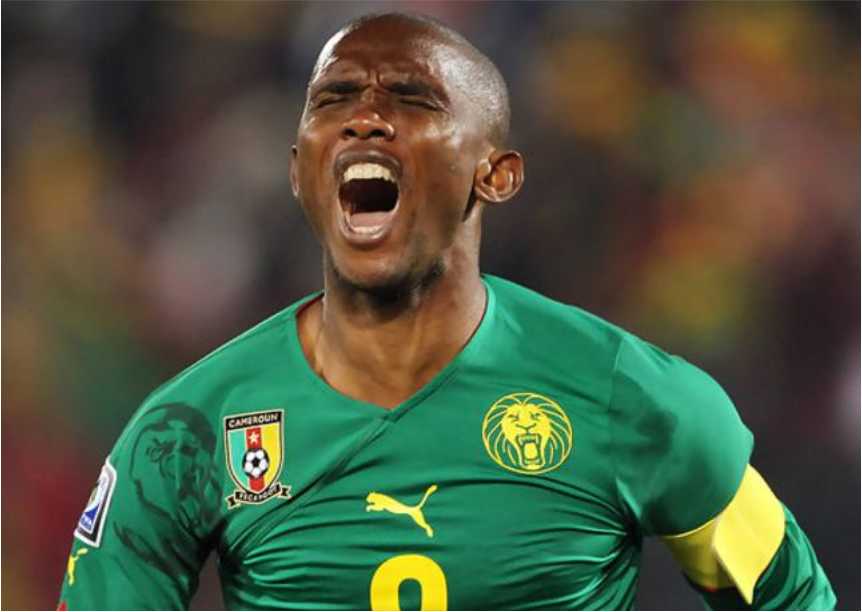
“He was little, lively and loved football,” recalled Jean Rene Noubissi, who took Eto’o under his wing as he was starting out at local side UCB.
“He calls me his first president. I helped oversee his development. When he played for UCB, he scored goals in every game and I would give him a little bonus as a reward.
“Even then you could see the discipline he had. He believed in his potential and knew where he wanted to go.”
The walls of Noubissi’s cramped office in the Akwa business district are covered in pictures of him with Eto’o, including one with Barcelona president Joan Laporta.
‘Role model’
Eto’o played for Real Madrid and starred for Mallorca before joining Barcelona.
But before all of that, he went to France to try his luck only to return home with his tail between his legs.
“When he came back, he had no club but he was still very famous, everybody knew about him in Douala. When he was just 14, he was the one feeding the whole family,” said Hiondi Nkam, author of a new book about Eto’o called “Les Anges et Les Demons” (Angels and Demons).
He was not yet 16 when he made his international debut and barely 17 when he went to the 1998 World Cup after newly appointed coach Claude Le Roy decided he could not ignore such a precocious talent.
“I wanted to give a chance to all the locally based players to see if there were any gems among them and I saw this young player who seemed so comfortable tactically and so intelligent,” Le Roy said.
“He was just a kid but he wasn’t afraid of all the big names in the team.”
Having retired from playing in 2019 aged 38, Eto’o has quickly transitioned into a leadership role off the field and in December, he was elected president of Cameroon’s Football Federation.
“People believe that he is not there for money or fame, but he is there to help,” said Nkam, who sums up what Eto’o means to New Bell. He is a role model. He was selfish on the field of play but very, very human off it. Some people would say that after God comes Samuel Eto’o.”
A fresh start for Cameroon
The campaign Eto’o ran was focused on promoting women’s football and eliminating corruption in the Cameroonian game. Beyond the highly-visible Africa Cup of Nations – BBC and Sky in England announced a broadcast deal that covered all 52 matches; corruption allegations have been a dominant issue within the Cameroon football federation.
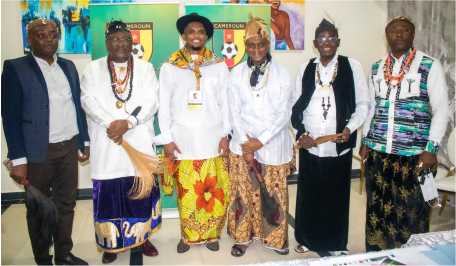
“During the campaign…Eto’o said the days when players paid to play on the national team, ‘those days are over,'” reports DW Yaoundé correspondent Moki Edwin Kindzeka. “Those who merit playing on the national team will be called up to play.”
Eto’o filed his candidacy just weeks before the 2021 vote, saying “I will be the next president of the federation despite all the cheating.” In Eto’o’s eyes, his predecessor Njoya, whose election was annulled by the International Court of Arbitration for Sport in 2018, had “failed miserably” as president.
The 40-year-old received endorsements from other presidential candidates, who withdrew their own bids, as well as global stars such as former Barcelona teammate Lionel Messi and Cameroon international Roger Milla.
The four-time African Footballer of the Year was voted in for a four-year term in December 2021, defeating interim president Seidou Mbombo Njoya by 43 votes to 31 in the federation’s general assembly.
A two-time AFCON and three-time Champions League winner with 118 appearances and 56 goals for Cameroon, Eto’o called his election “one of the proudest moments” of his life.
Traditional honour
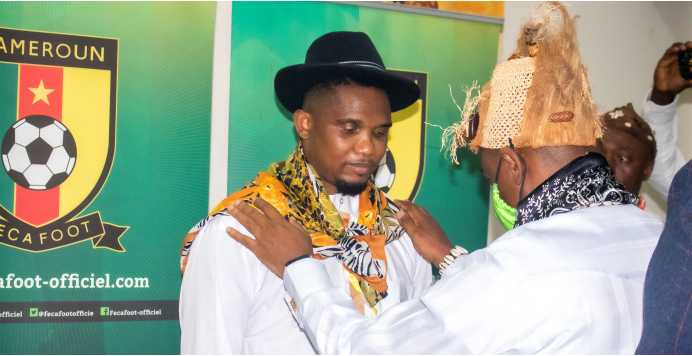
Eto’o was conferred the honour of peace maker after he was dressed in a traditional attire by the South West Paramount Chiefs led by HRM Chief Robert Esuka Endeley of Buea. Eto’o was honoured as a result of his success, personality and discipline.
“This is very significant for us, because 70% of Cameroonians are made up of youthful people and Eto’o Fills is a symbol of success in the country; he stands as a role model to our youths and lots of people in this country and we as traditional rulers, decided to crown him to the honour of peacemaker. No matter where you come from, our unity is very much paramount to the success of the nation and we believe he is going to take our sport to another level.”
Magazine
500 Vacancies Unfilled: Why Nigerian Companies Must Invest in Training Talent By Naija Diaspora Magazine

Business
UBA Cameroon and MINJEC Renew Strategic Partnership to Accelerate Youth Financial Inclusion in Cameroon
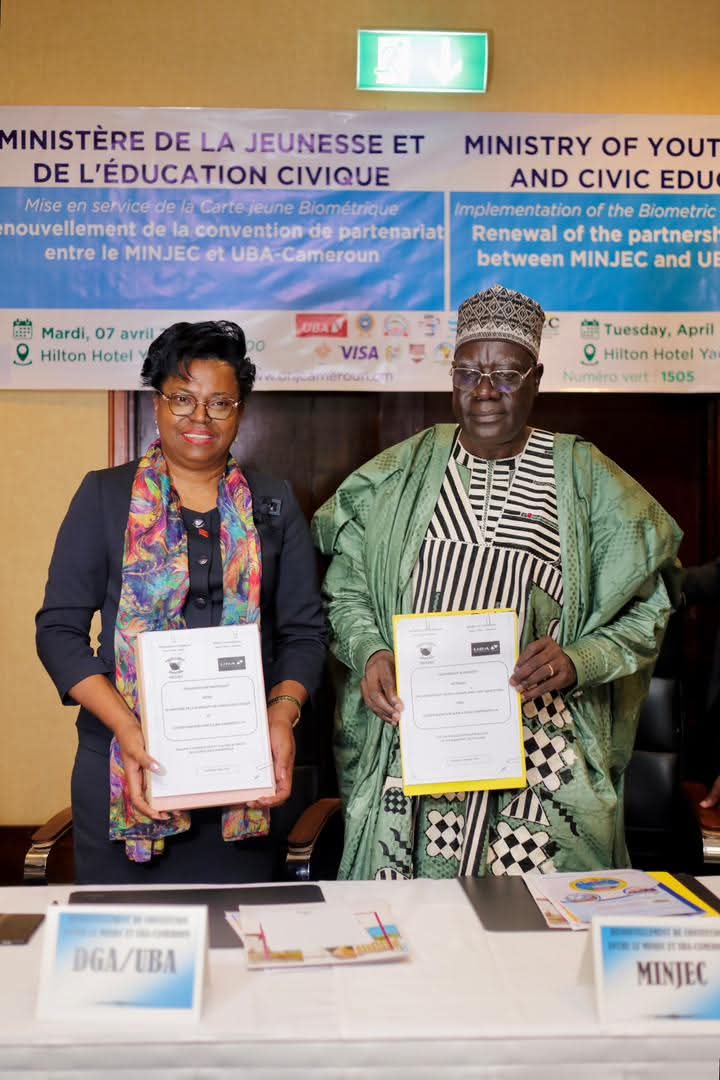
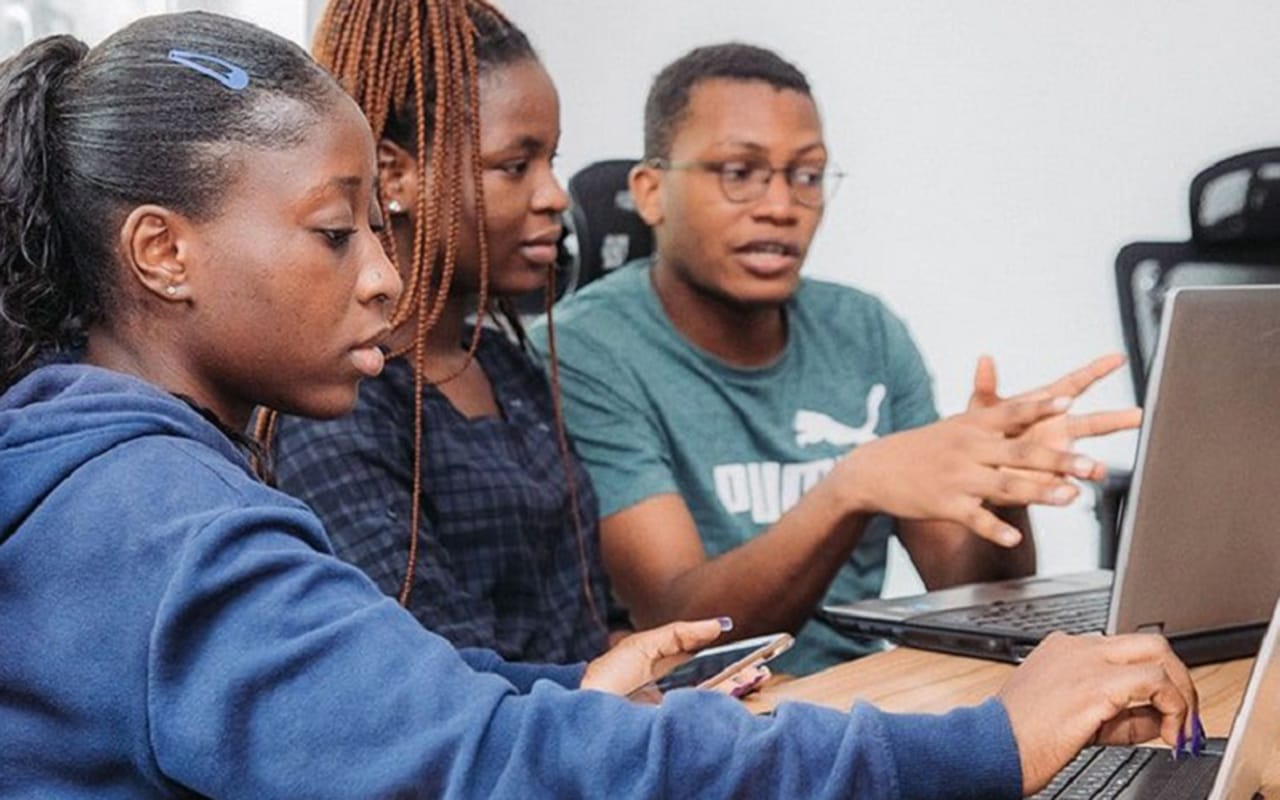
In a renewed push to expand financial access and strengthen youth participation in the digital economy, the Ministry of Youth Affairs and Civic Education (MINJEC) has reaffirmed its strategic partnership with UBA Cameroon, signaling a deepened commitment to financial inclusion, innovation, and youth empowerment in Cameroon.
The renewed agreement was formally signed by the Minister of Youth Affairs and Civic Education, Mr. Mounouna Foutsou, alongside the Deputy Managing Director of UBA Cameroon, Mrs. Jeanne Anie Ekeme. The partnership underscores a shared vision between both institutions to equip young people with the tools needed to actively participate in the formal financial system and the evolving digital economy.

At the center of this collaboration is the Biometric Youth Card initiative, a flagship project designed to serve as a gateway for young Cameroonians into financial services. Beyond simplifying access to banking solutions, the initiative is expected to enhance financial literacy, encourage savings culture, and promote entrepreneurship among young people across the country.
In an increasingly digital world where financial access plays a critical role in shaping opportunities, stakeholders say the initiative represents more than a banking solution—it is a pathway to economic inclusion and empowerment for a generation that holds the future of the continent.
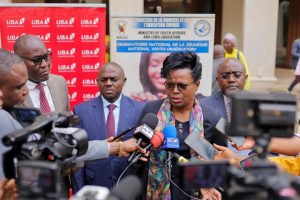
UBA Cameroon continues to position itself as a key driver of financial innovation and inclusion in the region. Through partnerships such as this, the institution reinforces its long-standing commitment to youth-focused development programs, aligning financial services with broader socio-economic impact.
For MINJEC, the renewed collaboration reflects its continued drive to bridge the gap between civic engagement, education, and economic empowerment, ensuring that young citizens are not left behind in the country’s development journey.
As Africa’s youth population continues to grow, initiatives like this highlight a broader continental shift toward inclusive financial systems that prioritize access, innovation, and opportunity.
For the diaspora community and readers of Naija Diaspora Magazine, this development resonates beyond Cameroon. It reflects a larger African narrative—one where young people are increasingly recognized not just as beneficiaries of development policies, but as active architects of economic transformation across the continent.




500 Vacancies Unfilled: Why Nigerian Companies Must Invest in Training Talent By Naija Diaspora Magazine

Cynthia BULOT

Equatorial Guinea 2035: A Bold Vision for Sustainable, Inclusive, and Globally Integrated Growth


