
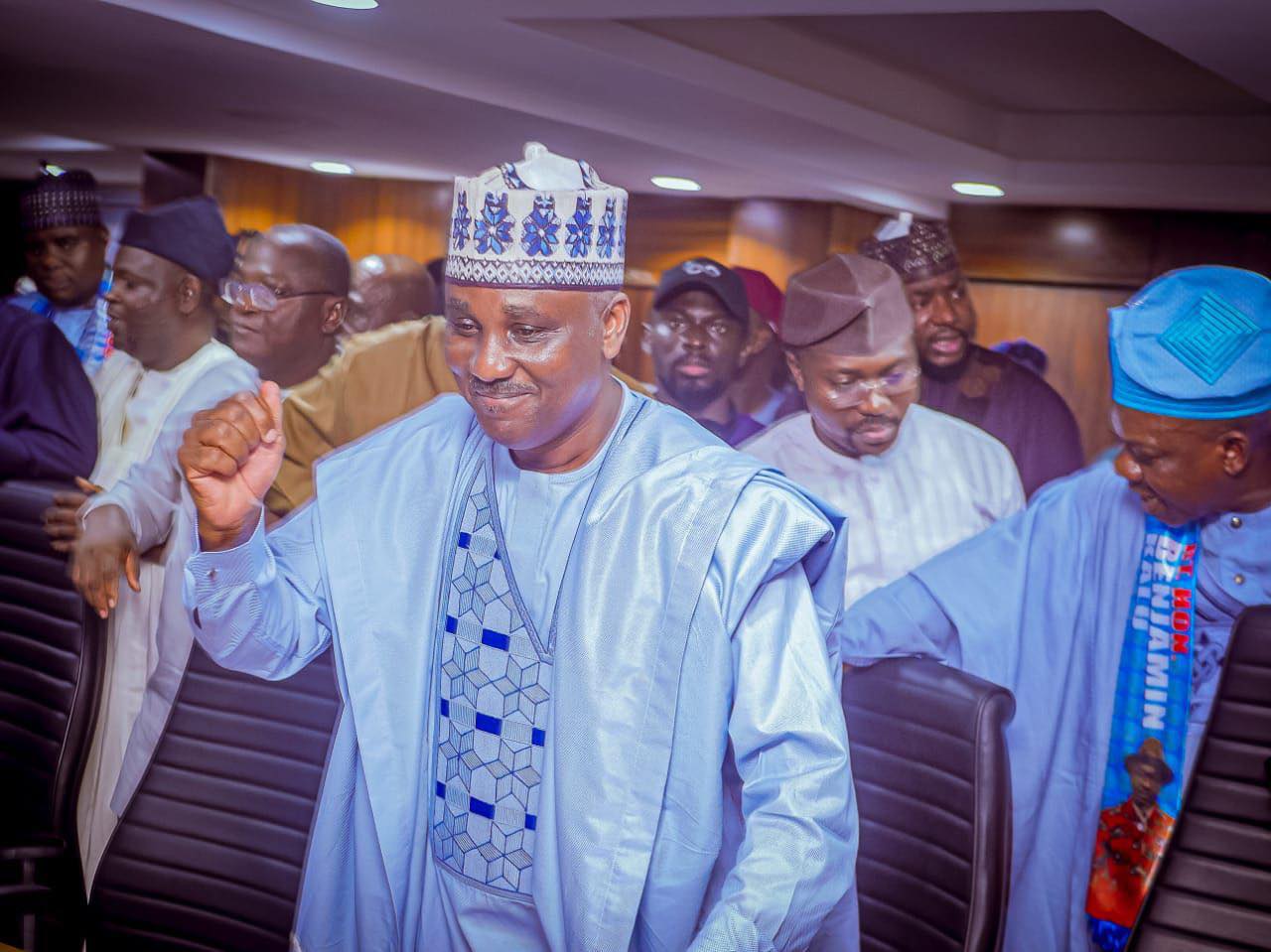
The emergence of the 10th Speaker, House of Representatives, Honorable Tajudeen Abbas followed the pattern of Senate President, Senator Godswill Akpabio on the same Tuesday, June 13, 2023 the lawmaker representing Zaria Federal Constituency mounted the top seat.
This followed a whirlwind of political spectacle, relentless campaigning, and intense horse trading. Godswill Akpabio, the “uncommon” former governor of Akwa Ibom state, has ascended to the throne of the senate president, wielding the gavel, while Tajudeen Abbas, claimed the mantle of leadership in the house of representatives.
Akpabio and Abbas were anointed by the All Progressives Congress (APC) as its preferred candidates for the positions. Taking lessons from past experiences, the ruling party took every necessary measure to ensure its nominated candidates are elected.
Abbas was elected in an “openly declared” ballot system, having scored 353 votes out of 359 to defeat fellow contenders, Ahmed Wase and Sani Jaji, who polled three votes each.
The ruling All Progressives Congress (APC) had earlier favored and consequently put forward Abbas and Honorable Benjamin Kalu as Speaker and Deputy Speaker.
Despite this decision of the ruling party to present the duo for the position, other contestants, particularly the G-7 group, had vowed to continue in the contest for the speakership seat.
But about three days before the contest, Honorable Muktar Aliyu Betara and Yusuf Adamu Gagdi dropped their ambition, after meeting with President Bola Tinubu and Vice President Kashim Shettima.
Honorable Ahmed Wase and Sani Jaji, however, went on to contest for the position.
The process began before 10:00 am, as the Deputy Clerk of the National Assembly, Kamoru Ogunlami, alongside the Clerk of the House of Representatives, presided over the session.
Birthed into royalty, Abbas was born three years after Nigeria gained independence on October 1, 1963, into a ruling family in the Zazzau Emirate nestled in the ancient city of Zaria, Zaria LGA of Kaduna state.
He holds the traditional title of Iyan Zazzau. His great-grandfather was an emir in the Zazzau Emirate. He comes from the Mallawa dynasty of the emirate. Meanwhile, his mother hails from Dutsen Kura in Malumfashi LGA of Katsina state.
By the dictators of the longstanding tradition, Abbas finds himself within the sacred order of succession. He is in line to ascend the illustrious throne as the Emir of Zazzau.
From tender years, little Abbas radiated an aura of exceptional greatness, embodying the rare qualities of a child predestined for the zenith.

Abbas was enrolled at the LEA Primary School, Lemu, Zaria, where he obtained his first school leaving certificate (FSLC). Continuing in his pursuit of knowledge, he went to the Government Secondary School in Makarfi, where he acquired the West African Examination Certificate (WAEC) in 1978.
With an insatiable hunger for academic excellence, he obtained a Grade I certificate at Kaduna Teacher’s College in 1981. Abbas then proceeded to Ahmadu Bello University in Zaria where he studied accounting and bagged a diploma in 1984.
His academic odyssey continued unabated as he obtained a B.Sc in business administration from Ahmadu Bello University in 1988. He bagged an M.Sc in business administration from the same institution in 1993. Abbas went further to get a PhD from Usman Dan Fodio University in Sokoto.
He also obtained another B.Sc in Business Administration Management from Usman Dan Fodio University.
CAREER IN CIVIL SERVICE
Abbas’ journey is a captivating tale that saw him blossom from the position of a primary school teacher to an esteemed senior lecturer at the university.
Abbas was a primary school teacher from 1981 to 1988. In June 1998, Abbas decided to temporarily veer away from the familiar path of civil service. He delved into the private sector, joining the Nigerian Tobacco Company (NTC) Plc in Jos. For three years and three months, he held the esteemed position of a general manager, navigating through the complexities of the industry.
Abbas later joined the Nuhu Bamalli Polytechnic in September 2001, where he lectured until June 2005.
A month after, Abbas embarked on a new chapter at the Kaduna State University. With determination and dedication, he ascended the ranks, reaching the pinnacle of a senior lecturer, a testament to his profound knowledge and commitment.
Yet, just when his academic career seemed to have reached its zenith, the allure of politics beckoned. In 2010, Abbas made the audacious leap into the unpredictable murky waters of politics, bidding farewell to the halls of academia.
PARLIAMENTARY VOYAGE
Abbas was first elected to the federal house of representatives on the platform of the now-defunct Congress for Progressive Change (CPC) in 2011.
In a stunning display of support, he triumphed once again in the 2015 elections, this time on the platform of the All Progressive Congress (APC). Abbas took on multiple roles as a member of various committees within the hallowed green chamber.
He was the deputy chairman of the house committee on legislative compliance between 2011 and 2015. Following the inauguration of the house in 2019, he was appointed to chair the committee on land transport.
Tajudeen was also saddled with other legislative ad hoc assignments in the lower legislative chamber. In 2019, he was appointed as the treasurer of the Commonwealth Parliamentary Association (African chapter).
He was a member of the governing council of the Nigerian Institute of Legislative and Democratic Studies (NILDS) where he represented the north-west geo-political zone from 2019 to 2023. Abbas was
the APC Kaduna caucus leader in the house of representatives, a position he held since 2019. In 2021, he was appointed the chairman of the house of representatives sub-committee on the constitutional review conference for the north-central.
Despite the numerous roles he handled, Abbas did not take a back seat in delivering his core constitutional mandate of lawmaking. He sponsored several bills and motions. The lawmaker is described by his colleagues as a “silent achiever”.
During his four years stint in the 9th lower legislative chamber, he sponsored 74 bills; out of this extraordinary tally, over 18 received presidential assent.
Until recently, many Nigerians were oblivious of his remarkable achievements as Abbas humbly shied away from the limelight.
In recognition of his exceptional legislative achievement, OrderPaper Nigeria, a news media organization dedicated to reporting parliamentary affairs, recently bestowed upon Abbas an award for being among the top performers in the 9th national assembly.
MAN OF MANY FIRSTS
In the course of his career, Abbas has had the golden chance to blaze the trail, sculpting a formidable bedrock for those after him.
 He is the only federal lawmaker from the north-west geo-political zone who has thus far sponsored an unprecedented 74 bills. He is also the first since the return to democracy in 1999 to have sponsored such a number of bills and remains the first to have over 20 signed into law.
Abbas was the pioneer head of the Department of Accounting and Finance, Nuhu Bamalli Polytechnic, Zaria. He also pioneered the Department of Business Administration at the same institution.
The legislator was the pioneer head of the Department of Accounting at Kaduna State University.
Aside from the fact that Abbas was the anointed candidate of the APC, he was also the preferred candidate of Femi Gbajabiamila, his predecessor.
Speaking during an interview, Abbas said the 10th national assembly won’t be a rubber stamp under his watch.
With Abbas ascending the throne of the number four seat in the country, all eyes are fixed on him, as he orchestrates the symphony of the green chamber over the course of the next four years.
