

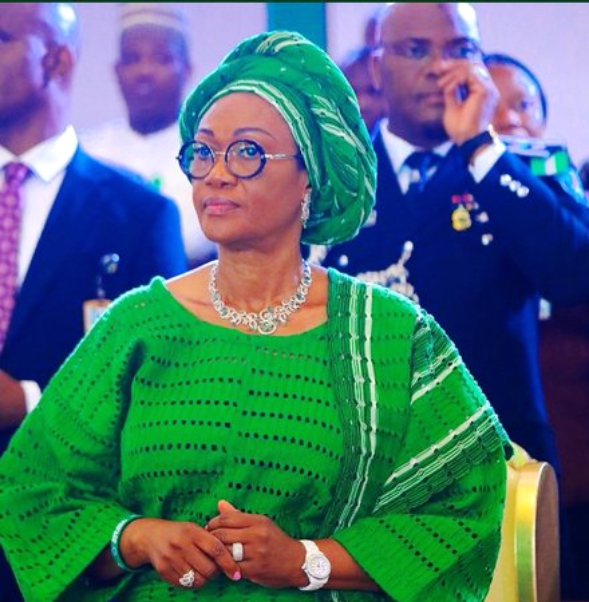
In the pulsating heart of Nigerian politics, where the echoes of ambition and the resonance of change collide, Oluremi Tinubu’s career illuminates the path for countless others, defying boundaries and shattering barriers in a realm dominated by men. With grace and resilience, she has carved her name into the annals of history as a leader whose journey represents the essence of equality and empowerment in public service.
Oluremi Tinubu was born on September 21, 1960, in Ogun State, Nigeria. She hails from a humble background and was raised with solid family values. Education was crucial in her household, and she pursued her academic goals with determination. She attended primary and secondary schools in Lagos before proceeding to the University of Ife (now Obafemi Awolowo University) in Osun State, Nigeria.
Oluremi Tinubu’s journey into politics began when she joined the Social Democratic Party (SDP) during the transition to democracy in the early 1990s. However, it was in 1999, with the return of democracy to Nigeria, that she made her first major foray into politics.

Following her husband’s successful election as Governor of Lagos State in 1999, Oluremi Tinubu became the First Lady of the state. During her time in this role, she focused on several key issues, particularly those affecting women, children, and the less privileged in the society. She initiated and supported various programs aimed at empowering women and improving their access to education, healthcare and economic opportunities.
As the first lady, Oluremi Tinubu founded the New Era Foundation, with the mission to establish centers focusing on the all-round development of the youth and to raise public awareness about environmental health and community service.
After her tenure as First Lady of Lagos state, Oluremi Tinubu decided to venture into active politics. In 2011, she contested for a seat in the Nigerian National Assembly and was elected as a Senator representing Lagos Central Senatorial District.
Senator Tinubu’s election faced a challenge at the Legislative House Election Petition Tribunal when she was first elected. However, the tribunal later upheld the election in 2012.
In the 8th assembly of 2015, Tinubu was among the 100 senators elected, with only six of them being women, among which were Stella Oduah and Uche Ekwunife, both representing Anambra, as well as Fatimat Raji Rasaki, Rose Okoji Oko and Binta Garba.
During a closed-door session in the Senate in 2016, Senator Tinubu raised concerns about her safety and requested adequate security from the Inspector General of Police due to an alleged threat of assault by her colleague and fellow party member, Dino Melaye.
She represented the Lagos Central Senatorial District under the All Progressives Congress (APC) banner, having won re-election in the March 28, 2015 elections, continuing to serve the people of Lagos Central.
Again, in the subsequent 2019 general elections, she successfully retained her senatorial seat, marking her third term in office, receiving recognition in the same year at the Eko Excellence Awards, sharing the spotlight with prominent figures like Babajide Sanwo-Olu and Tony Elumelu. In 2020, she actively advocated for the establishment of state police as a viable solution to combat the escalating insecurity issues within the nation.
In March 2021, Senator Tinubu presented a bill aimed at reforming the Nigerian Postal Service (NIPOST), seeking to enhance its viability as an entity.
As a Senator, Oluremi Tinubu was actively involved in legislative matters and championed several bills and motions aimed at addressing critical issues in her constituency and Nigeria as a whole. Her focus remained on education, women’s rights, youth empowerment and social development.
Oluremi Tinubu has made considerable philanthropic efforts to alleviate the suffering of the less privileged, with a particular focus on empowering girls and women in her constituency.
Her influence extended beyond Nigeria’s borders, as she actively participated in international forums, advocating for women’s rights on the global stage. Her contributions in forums like the United Nations further solidified her reputation as a steadfast champion for gender equality, earning her the respect and admiration of leaders worldwide.
Beyond the political sphere, Oluremi Tinubu’s philanthropic endeavors are equally commendable, as she spearheaded community-based initiatives, ranging from healthcare programs to educational scholarships, leaving an indelible mark on the lives of countless individuals.
With her strong belief in investing in society’s human capital, Oluremi has demonstrated this through her Youth Empowerment and Skill Acquisition Scheme in partnership with the Good Boys and Girls Empowerment Scheme (GBGES), which has successfully empowered 1,172 beneficiaries. Notably, 164 young individuals were trained in various skills and provided with startup kits, as well as a capital of approximately N40,000 each.
In acknowledgment of her remarkable achievements and contributions to the betterment of society, she received local and international honors. Some of these accolades include the National award of the Officer of the Order of the Niger [OON], fellowships at both Adeyemi College of Education, Ondo, and College of Education, Ikere-Ekiti, as well as being a member of the Board of Trustees of Kings’ University, Ode-Omu. She has also been honored with the Ghana Noble International Award for Leadership (2004) and the Gambian Diamond Award for her significant contributions to uplifting people from poverty (2005). Furthermore, she holds many citations and chieftain titles in recognition of her outstanding accomplishments. Her exceptional efforts as a senator earned her the prestigious award for the most impactful female legislator at The Guardian-organized International Women’s Day Summit in 2021.
To celebrate her role model status and impactful contributions, the AFAO/WAWA (Association Des Femmes De L’Afrique De L’Ouest/West African Women Association) named the Oluremi Tinubu Women Training Centre in Gorom, Senegal, in her honor.
With the recent election of her husband, Bola Ahmed Tinubu, as the President of Nigeria, Oluremi Tinubu again steps into limelight as she takes on a new role as the First Lady of the country on July 5th, 2023. Being the wife of the President, she holds a unique position to champion positive causes and play a pivotal role in shaping the country’s social and political landscape. However, the internet in no time began to buzz with responses to a viral photo featuring the First Lady, reportedly attending a high-level economic meeting with President Bola Tinubu and Vice President Kashim Shettima.
According to reports, the photograph was captured during a crucial meeting at the Presidential Villa in Abuja, where President Tinubu was in discussion with the Governor of the Central Bank of Nigeria, Godwin Emefiele and the Group Chief Executive Officer of Nigerian National Petroleum Company Limited (NNPCL), Mele Kyari. The meeting revolved around significant economic issues.
The image sparked curiosity and speculation, drawing widespread attention and mixed reactions from the public and media alike.
On July 14th, First Lady Oluremi Tinubu convened a meeting with the wives of the 36 state governors to formally introduce and familiarize them with the goals and mission of the Renewed Hope Initiative (RHI), which is a project associated with her office and has been established with the primary aim of addressing socio-economic challenges and uplifting marginalized women and children, by providing them with valuable skills, essential healthcare services and educational support, while also promoting entrepreneurship development.
During the meeting, she urged the governors’ wives to utilize their positions to make a meaningful impact on the lives of the people in their respective states. She reminded them of the importance of delivering on every promise made during election campaigns, emphasizing the urgency of taking concrete actions to improve the well-being of their constituents.
Oluremi Tinubu continues to demonstrate a commitment to public service, as a vocal and influential personality.
