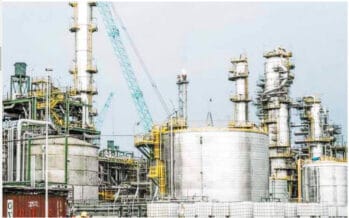
The Organization of Petroleum Exporting Countries (OPEC) has said the much-awaited Dangote Refinery’s refining capacity would account for more than half of Africa’s expected total additional distillations in the medium term.
The international oil cartel which stated this in its latest World Oil Outlook (WOO), disclosed that the addition was estimated at 1.2 million barrels per day in the medium term, stressing that the refinery which has a capacity of 650, 000 barrels per day, would take the lion’s share.
Apart from the asset owned by Africa’s richest man, also expected to begin production in the near future are that 100 tb/d refinery to be built in Soyo, Angola, the 110 tb/d Hassi Messaoud refinery expansion in Algeria, the 160 tb/ d Midor refinery expansion in Egypt, the 10 tb/d Brahms modular refinery in Guinea and the 110 tb/d Pointe Noire II refinery in the Republic of Congo.
In addition, Ghana and Senegal are also expected to commission new units, most of which are modular, to address fast-growing demand in Africa.
“In Africa, medium-term distillation additions are estimated at around 1.2 mb/d. More than a half of this number is accounted for by Nigeria’s Dangote refinery (650 tb/d).
“According to recent reports, its commissioning is likely to be delayed from 2022 to 2023, partly due to financial issues. Furthermore, Nigeria is likely to see the addition of a number of small modular refineries with capacities of up to 20 tb/d over the medium-term, thus adding much needed capacity in the country,” OPEC stressed.
“Elsewhere, a new 100 tb/d refinery is likely to be built in Soyo, Angola in 2025. In North Africa, a modest expansion is expected in Algeria (Hassi Messaoud) and Egypt (Midor and Assiut).
“Finally, several sub-Saharan countries, including Ghana, Guinea, Senegal and the Republic of the Congo are expected to commission new units, most of which are modular. With these expansions, the region will look to address fast growing demand, but it could also potentially reduce product imports from other regions,” OPEC noted.
In addition to the Dangote refinery, rehabilitation is going on in Warri and Port Harcourt and work on the Kaduna refinery will start soon, with the report stating that if the refurbishments succeed, Africa could expect even higher outputs and utilization rates in the long term.
“These additions could lead to refinery throughputs increase from 1.8 mb/d in 2021 to 4.8 mb/d in 2045, based on strong demand growth and refining capacity additions in both the medium- and long-term,” it added.
OPEC acknowledged that the downstream market has tightened significantly over the last year, driven by strong oil demand growth, a decline in available refining capacity and geopolitical uncertainties.
During the medium-term (2022-2027) it noted that around 7.3 mb/d of the Middle East (1.6 mb/d) and Africa (1.2 mb/d).
“Refining capacity additions in other regions are minor and mostly limited to the expansion of existing refineries,” it added.
In the long-term, (2022-2045) OPEC stated that global refining additions are projected at 15.5 mb/d, with a significant slowdown in the rate of additions towards the end of the projection period.
“Almost 90 percent of additions are located in the Asia-Pacific, the Middle East and Africa,” he said.
The medium-term balance, it stressed, points to a tightening downstream market relative to 2021, with the estimated deficit of potential refining capacity relative to required refining capacity set to peak around 2.7 mb/d in 2023 and 2024.
“Due to the demand growth slowdown and continuous capacity additions, the deficit is set to decline to around 1.4 mb/d in 2027,” the report said.
The Dangote integrated refinery and petrochemical complex in the Lekki Free Zone, near Lagos, Nigeria, is expected to be the world’s biggest single-train facility, upon commissioning.
Estimated to cost about $20 billion, the refinery will produce Euro-V quality petroleum and diesel, as well as jet fuel and polypropylene and will likely generate 4,000 direct and 145,000 indirect jobs.
The new refinery will double Nigeria’s refining capacity and help in meeting the increasing demand for fuels, while providing cost and foreign exchange savings. It is estimated to have an annual refining capacity of 10.4 million tonnes of petroleum.
In a renewed push to expand financial access and strengthen youth participation in the digital economy, the Ministry of Youth Affairs and Civic Education (MINJEC) has reaffirmed its strategic partnership with UBA Cameroon, signaling a deepened commitment to financial inclusion, innovation, and youth empowerment in Cameroon.
The renewed agreement was formally signed by the Minister of Youth Affairs and Civic Education, Mr. Mounouna Foutsou, alongside the Deputy Managing Director of UBA Cameroon, Mrs. Jeanne Anie Ekeme. The partnership underscores a shared vision between both institutions to equip young people with the tools needed to actively participate in the formal financial system and the evolving digital economy.
At the center of this collaboration is the Biometric Youth Card initiative, a flagship project designed to serve as a gateway for young Cameroonians into financial services. Beyond simplifying access to banking solutions, the initiative is expected to enhance financial literacy, encourage savings culture, and promote entrepreneurship among young people across the country.
In an increasingly digital world where financial access plays a critical role in shaping opportunities, stakeholders say the initiative represents more than a banking solution—it is a pathway to economic inclusion and empowerment for a generation that holds the future of the continent.
UBA Cameroon continues to position itself as a key driver of financial innovation and inclusion in the region. Through partnerships such as this, the institution reinforces its long-standing commitment to youth-focused development programs, aligning financial services with broader socio-economic impact.
For MINJEC, the renewed collaboration reflects its continued drive to bridge the gap between civic engagement, education, and economic empowerment, ensuring that young citizens are not left behind in the country’s development journey.
As Africa’s youth population continues to grow, initiatives like this highlight a broader continental shift toward inclusive financial systems that prioritize access, innovation, and opportunity.
For the diaspora community and readers of Naija Diaspora Magazine, this development resonates beyond Cameroon. It reflects a larger African narrative—one where young people are increasingly recognized not just as beneficiaries of development policies, but as active architects of economic transformation across the continent.
In a landmark move showcasing African vision, innovation, and enterprise, Kadji Group, the renowned Cameroonian industrial conglomerate, has expanded its footprint into Nigeria. Inspired by the legacy of its founding father, the late Patriarch Fu’a Toula Kadji Defosso, his values, and his enduring vision, the group is proving once again that Africa’s future is built by Africans.
Through its brewing division, Ultimum Limited, Kadji Group is taking bold strides in the sub-region. Following the success of the Cameroonian Brewery Union (UCB)—the first 100% Cameroonian and African brewery in Central Africa since 1972—the group has now made a strategic investment in Aba, Abia State, Nigeria.
On March 25, 2026, Ultimum Limited inaugurated the first PET production line at its Aba facility, dedicated to producing popular brands Razzl, KIQ, and more. This milestone marks a historic moment not only for the Kadji Group but for Cameroon’s industrial presence in Nigeria.
Why Nigeria?
Nigeria is more than a neighboring country—it is Cameroon’s key economic and trade partner in Africa. With a population of over 220 million consumers, it offers unparalleled opportunities for African entrepreneurs.
The progressive implementation of the African Continental Free Trade Area (AfCFTA) further amplifies this opportunity, enabling integrated markets and fostering cross-border business growth.
Aba: A Strategic Hub
Aba is not just a city—it is the economic heart of Abia State, a thriving commercial and industrial hub whose influence stretches across Central and West Africa. With a skilled workforce, robust production capacity, and extensive trade networks, Aba serves as a vital crossroads for the distribution of goods throughout the region.
Its industrial landscape spans pharmaceuticals, cement, textiles, footwear, cosmetics, leather processing, metal manufacturing, and agro-food industries, including beverages. Most of Nigeria’s leading national beverage operators maintain production facilities in Aba.
At the center of Aba’s commercial dynamism is the Ariaria International Market, with over 37,000 shops and stalls. Known as “the China of Africa” for its bustling industrial and trade activity, this regional market attracts traders from Nigeria, Ghana, Cameroon, Gabon, Liberia, Togo, Benin, Congo, Equatorial Guinea, and Côte d’Ivoire.
The decision to invest in Aba was also shaped by the visionary leadership of Governor Dr. Alex Otti, who has created real conditions for investors to establish, grow, and thrive in Abia State through infrastructure projects and dedicated support.
Strengthening Cameroon-Nigeria Ties
By acquiring a Guinness Nigeria facility in Aba and investing several billion CFA francs to build a state-of-the-art factory, Kadji Group is reinforcing economic ties between Cameroon and Nigeria while stimulating trade across the sub-region.
This investment demonstrates the group’s confidence in Africa and its unwavering commitment to creating value, generating growth, and remaining a leading industrial player across the continent.
A Virtuous Ecosystem: Social, Environmental, and Economic Impact
The impact of the Aba facility goes far beyond numbers. Today, over 100,000 clients across Africa rely on Kadji Group products to meet the daily needs of their families.indirect
From its very inception, the Ultimum Limited factory in Aba will generate hundreds of direct and indirect jobs for Nigerians and Cameroonians in a living area of over 30 million people, creating a ripple effect of social and economic empowerment across the region.
Appreciating Kadji Group Leadership
We at Naija Diaspora Magazine applaud the Kadji Group management for this visionary move. By bringing Cameroonian excellence to Nigeria, they are setting a new benchmark for African industrial collaboration. We assure our full support and collaboration, as this aligns perfectly with our mission to highlight African success stories, promote cross-border enterprise, and celebrate initiatives that empower communities across the continent
For 30 young entrepreneurs across Cameroon, a new chapter has just begun. The Tony Elumelu Foundation (TEF) has unveiled its 2026 cohort of entrepreneurs, bringing fresh opportunities for business owners across the country to access funding, training, and mentorship.
This year’s announcement, made by Nigerian philanthropist Tony Elumelu, introduces 3,200 entrepreneurs selected from over 265,000 applicants across Africa, with Cameroon once again featuring prominently among beneficiary countries.
For many young Cameroonians navigating a challenging economic environment, the programme represents more than funding; it is a pathway to stability, growth, and independence.
Cameroon, a big part of the Programme
Cameroon remains one of the Foundation’s strongest impact markets in Central Africa. To date, TEF-backed businesses in Cameroon have:
– Generated over $20 million in revenue
– Created more than 58,000 jobs
– Supported over 800 entrepreneurs across sectors
These businesses span agriculture, retail, technology, waste management, energy and cleantech, fintech, education and training, sectors that directly impact everyday life in Cameroon.
“We Chose You Because You Kept Going”
Announcing the new cohort on his birthday, Tony Elumelu shared a message of resilience and belief in African entrepreneurs: “We did not choose you because your path was easy. We chose you because you kept going when it wasn’t.” Each selected entrepreneur will receive $5,000 in seed funding, alongside training, mentorship, and access to a continent-wide network.
A Growing Footprint Across Central Africa
Beyond Cameroon, the programme continues to expand across the CEMAC region, supporting entrepreneurs who are driving business growth, job creation, and economic resilience.
Country
Annual Revenue (USD)
Jobs Created
Beneficiaries
Cameroon
20,255,550
58,703
896
Chad
17,874,317
53,465
614
Gabon
2,109,953
6,015
78
Congo (Brazzaville)
2,471,659
8,134
45
Central African Republic
602,844
1,904
29
Equatorial Guinea
421,991
688
28
Democratic Republic of Congo
9,042,656.00
37,438
466
Together, these figures highlight the growing role of entrepreneurship in shaping Central Africa’s economic future, with Cameroon emerging as one of the region’s leading hubs for TEF-supported businesses.
More Than Funding, A System of Opportunity
Since its launch, the Tony Elumelu Foundation has empowered thousands of entrepreneurs across Africa, helping them build businesses, create jobs, and support their communities. At the core of this effort is a simple belief: opportunity should not be limited; it should be accessible.
What This Means for Cameroon
At a time when youth unemployment and economic uncertainty remain key concerns, initiatives like the TEF Entrepreneurship Programme are playing a critical role in supporting self-employment, driving local business growth, and reducing dependence on traditional job markets. For many young Cameroonians, this is not just support, it is a chance to build something lasting.